Marketing moves fast. Add WebFX as a preferred source on Google and get our latest insights when you search.
Maria is a Lead Content Specialist at WebFX. With nearly two decades of experience in B2B and B2C publishing, marketing, and PR, she has authored hundreds of articles on digital marketing, AI, and SEO to help SMB marketers make informed strategic decisions. Maria has a degree in B.S. Development Communication major in Science Communication, and certifications in inbound marketing, content marketing, Google Analytics, and PR. When she’s not writing, you’ll find her playing with her dogs, running, swimming, or trying to love burpee broad jumps. View full profile
We analyzed 2.3 billion site sessions across numerous industries from January 2024 to December 2025 and found that generative AI traffic grew 796% in two years. Those visitors converted ~1.2x higher than organic search and outperformed every other “free” channel. Organic and direct still dominate (63% of sessions), while AI accounts for just 0.18%.
Note: This report was updated in March 2026 to reflect expanded data from January 2024 through December 2025. Earlier versions of this study (January 2024–February 2025) reported that generative AI traffic grew 165× faster than organic search. The updated analysis extends the dataset and timeframe.
AI-referred visitors aren’t just increasing. They’re more likely to convert.
In our analysis of 2.3 billion sessions (January 2024 to December 2025):
Traffic from generative AI grew 796% in two years.
AI visitors converted ~1.2x higher than organic search and at a higher rate than any other “free” channel.
Organic and direct still dominate (63% of sessions), while AI accounts for 0.18%.
What this means for marketers:
AI is changing when users arrive and how ready they are to act.
Visitors from generative AI often come after researching options, comparing vendors, and narrowing their choices. That means they’re more likely to take action when they land on your site.
At the same time, traditional channels like organic search and direct still drive the majority of early discovery.
The takeaway? The goal isn’t to replace SEO. It’s to capture both stages of intent:
Use SEO to generate awareness and early demand.
Use AI visibility to capture decision-ready buyers.
Let’s break down the data.
Generative AI has become a strategic traffic channel
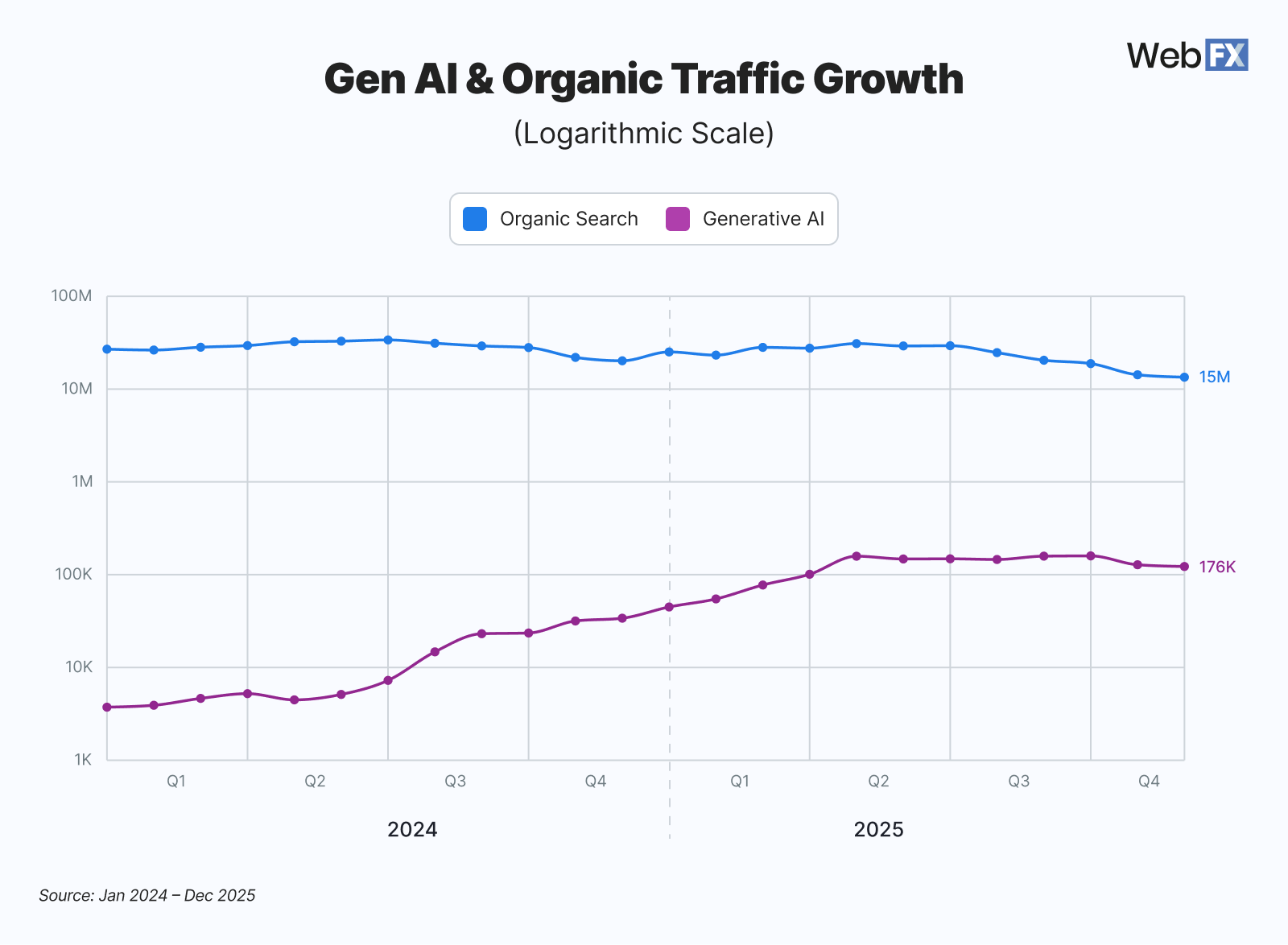
The logarithmic scale of Generative AI and Organic traffic from 2024 to 2025 shows that Gen AI’s growth isn’t a one-time spike, and Organic still drives significantly more traffic than Gen AI.
By 2025, generative AI traffic was no longer behaving like a one-time spike. Generative AI grew approximately 796% from January 2024 to December 2025.
The quarterly growth pattern also shows how the channel evolved, explaining why it now deserves strategic attention. Growth in 2025 unfolded in three distinct phases: early adoption, acceleration, and maturation.
Phase 1: Early adoption (January to April 2025). YoY growth ranged from 1,101% to 1,835%, driven by early adopters integrating generative AI platforms into research behavior alongside traditional search.
Phase 2: Acceleration (May to July 2025). May reached a peak of 3,431% YoY, followed by elevated growth through July. This period reflects broader adoption and increased frequency of AI-assisted research.
Phase 3: Maturation (August to December 2025). Growth moderated into the 260–889% range. Session volume remained elevated, while the rate of increase stabilized into a more consistent pattern.
These numbers indicate the channel is maturing and stabilizing. As AI becomes a larger part of the search journey, comparing changes in organic clicks, impressions, rankings, and click-through rates can help determine whether AI search is hurting your traffic.
Traffic share remains small, but strategically meaningful
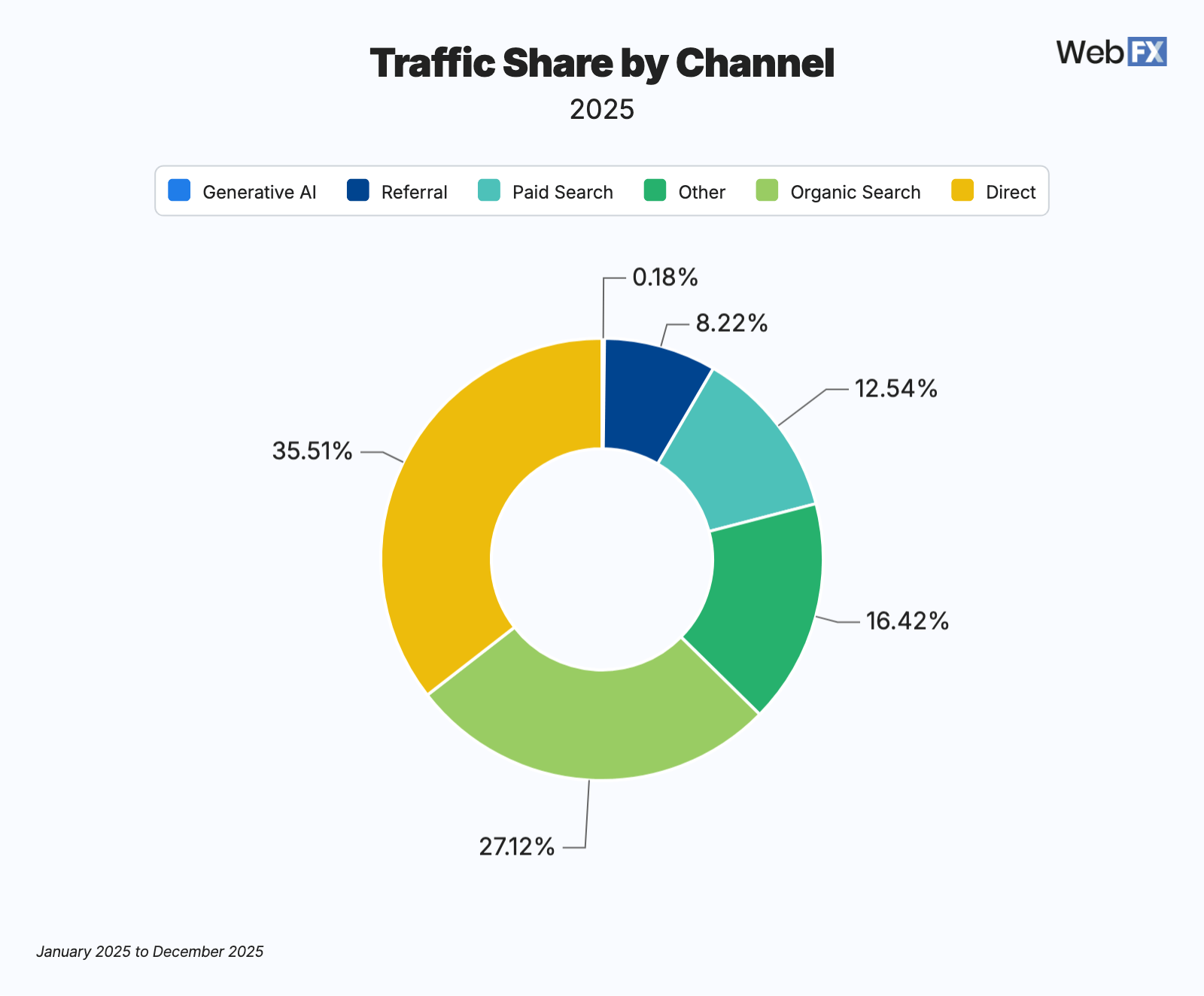
In 2025, generative AI accounted for 0.18% of total sessions. The share remains modest, yet its sustained growth and measurable conversion activity elevate its strategic relevance.
Organic Search still remains a primary traffic channel, though, holding the second-highest market share at 27.12% and trailing only Direct. Together, the two make up more than 60% of website traffic.
Traffic distribution across channels changed measurably in 2025, reflecting users’ evolving search and discovery behavior. When taken together, the quarterly growth pattern and traffic-share data show that generative AI is no longer an experimental referral traffic source. It is measurable, sustained, and tied to revenue activity.
Takeaways for marketers: Manage generative AI as a defined traffic channel
Generative AI should now be tracked, benchmarked, and forecasted like any other revenue channel.
Expert insights from
Sarah B.Lead Web Marketing Consultant
“Whether it’s happening in ChatGPT or Google’s AI Overviews, generative search is here to stay. Businesses looking to ride the wave need to start optimizing for these experiences.”
In GA4, you can look for GA4’s new AI Assistant traffic channel or create a dedicated channel grouping or source filter for traffic from generative AI platforms so it does not merge into generic referral buckets.
Track AI’s percentage of total sessions alongside raw session growth to understand how your acquisition mix is changing. Monitoring traffic share tells you whether AI is becoming an important contributor to your pipeline or simply expanding from a small base.
Session growth alone doesn’t tell you how important a channel is. Review conversion events per user and assisted conversion paths to measure generative AI’s revenue influence.
If AI-assisted sessions are high-quality (which means they lead to conversion actions), it may justify deeper content optimization or increased efforts to improve your visibility. If traffic quality is inconsistent, you may need to adjust your targeting or landing pages.
AI visitors are buyers, not browsers
From 2024 to 2025, sessions from generative AI platforms increased 796% YoY, while conversions increased by 6,432% YoY.
When conversions grow faster than sessions, it means a larger share of visitors are turning into leads, customers, or taking other meaningful actions. Generative AI traffic is not only expanding its reach but also improving conversion efficiency.
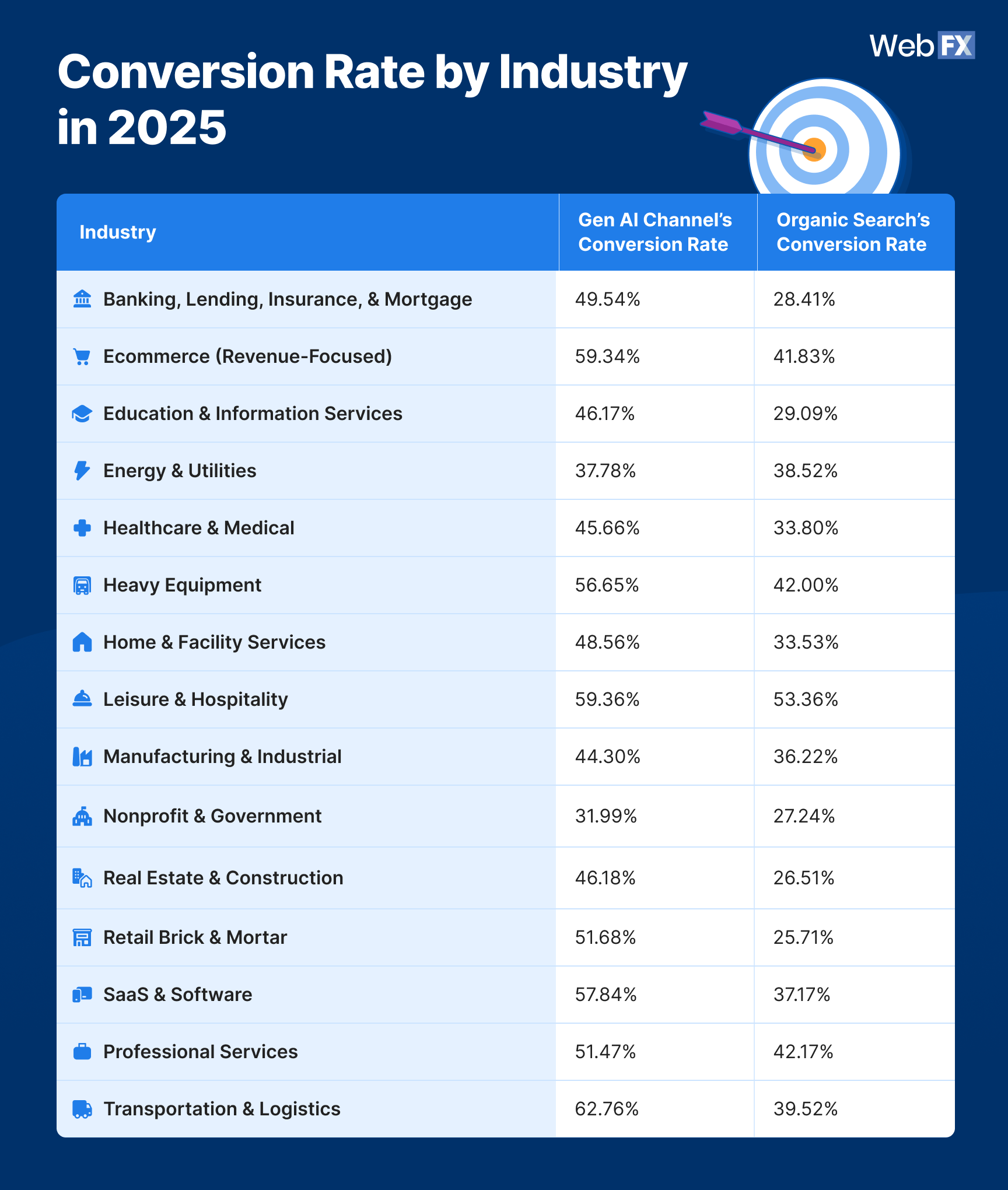
Across industries, users referred by generative AI consistently converted at higher rates than organic search throughout 2025. Industries like SaaS and Retail saw AI referrals convert at more than 50%, while organic search conversions were between 20 and 30%.
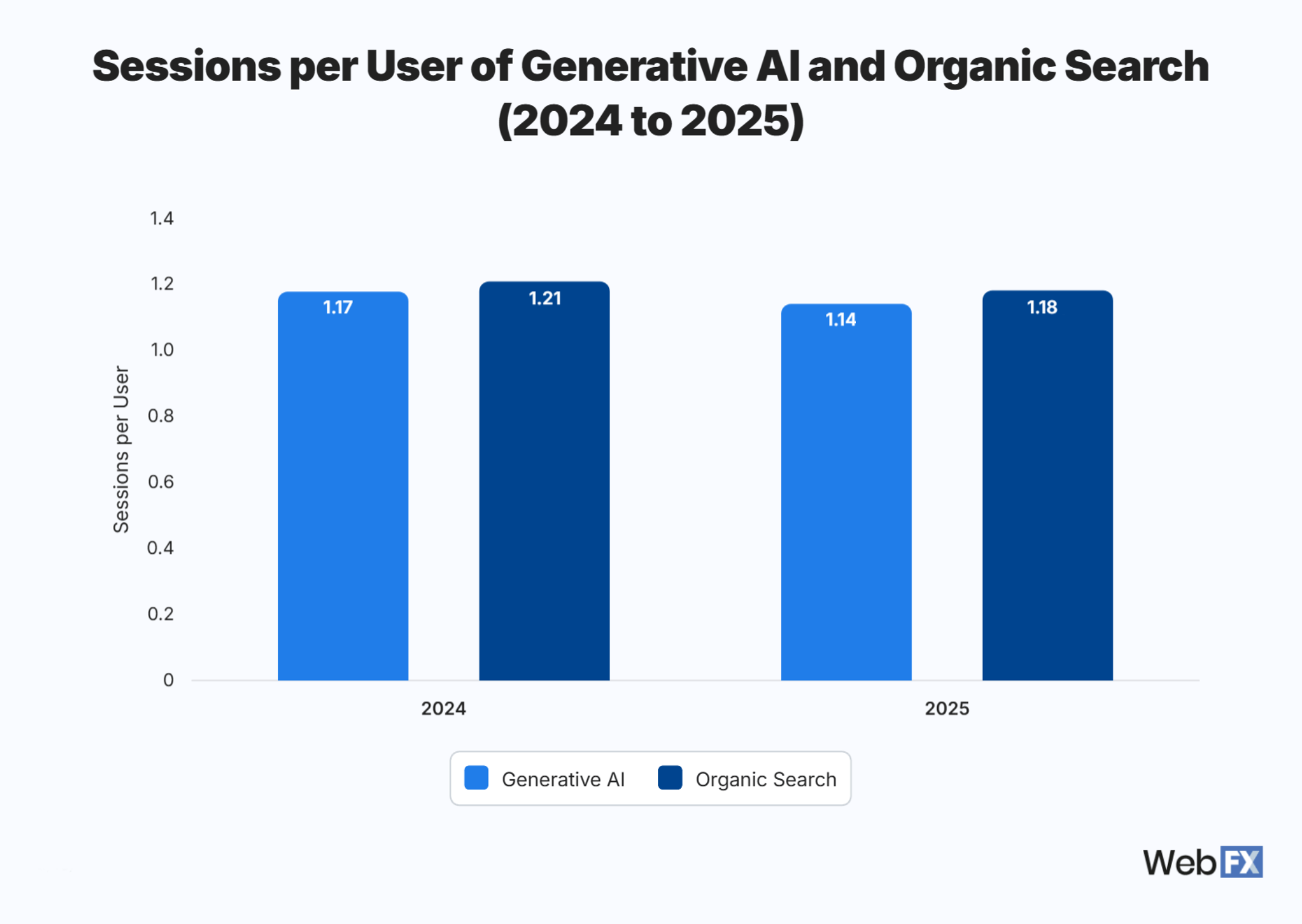
AI traffic had fewer sessions per user than organic search in both 2024 and 2025. In 2025, AI visitors averaged 1.14 sessions per user compared to 1.18 for organic search.
This pattern suggests less back-and-forth exploration. Many AI-referred visitors have already begun evaluating options elsewhere:
Inside AI platforms
Review sites
Industry publications
Community forums
When these users reach a company website, they’re confirming pricing, specifications, credibility, or contact information.
Sessions per User (Generative AI vs. Organic Search)
Channel
2024
2025
Generative AI
1.17
1.14
Organic Search
1.21
1.18
Generative AI traffic combines conversion efficiency with rapid growth
Generative AI delivered 0.79 tracked interactions per user. In practical terms, that’s roughly eight tracked interactions for every 10 visitors arriving from AI platforms.
For context, organic search generated approximately 12 tracked interactions per 10 visitors.
High-intent channels such as Affiliates and Paid Search generated even more interactions per visitor, which implies that visitors coming from these channels are in the earlier stages of their research.
Generative AI outperformed Direct, Organic Social, Referral, Paid Social, and Display in terms of tracked interactions per visitor. This places the generative AI channel in the middle tier of conversion efficiency — competitive but not the most efficient or highest-converting.
On its own, mid-tier efficiency is not unusual. What distinguishes generative AI is the combination of:
Approximately eight interactions per 10 visitors
796% YoY session growth
No direct media spend
No other unpaid channel grew this quickly while still driving meaningful conversion activity. This combination reflects a growing share of visitors arriving through AI platforms with meaningful conversion activity.
What marketers should do: Treat AI as a high-intent channel
Instead of looking at generative AI as a website traffic thief, think of it as a prequalification tool that your prospects use. For this reason, AI traffic behaves more like bottom-of-funnel traffic than early-stage discovery.
Visitors arriving from AI platforms are often validating options rather than beginning research. Optimize landing pages to clearly present key information that they’re verifying (such as pricing, specifications, comparisons, proof points, and contact information).
AI-driven visitors are more likely to convert when information is immediate and structured.
AI visitors averaged fewer sessions per user than organic search in both 2024 and 2025, yet generated several interactions with visitors. If you measure performance primarily on session depth or repeat visits, AI traffic may appear weaker than it is.
Benchmark AI performance against high-intent channels rather than informational organic queries.
With 796% YoY session growth and meaningful interactions per user, AI is no longer experimental traffic. Track it as a defined channel in your dashboards, revenue reporting, and forecasting models.
Tracking referral sources from AI platforms separately will prevent their impact from being absorbed into “referral” or “other” categories.
AI-driven visitors frequently arrive to confirm pricing, review technical details, or assess credibility. Ensure that your landing pages:
Provide clear pricing and technical information
Boost your brand’s credibility with proof points
Guide visitors to the next steps or conversion
As AI visibility increases, the ability to appear in AI-generated responses directly influences which brands receive this decision-stage traffic.
AI compresses research and changes how users engage on-site
Generative AI accounted for just 0.18% of traffic in 2025. While small, it’s unique: What sets it apart from other traffic sources is how AI-referred visitors behave when they land on a business’s website.
In 2025, generative AI recorded a 66.48% engagement rate and a 54.15% session conversion rate. Organic search, by comparison, recorded a 70.86% engagement rate with a 45.23% session conversion rate during the same period.
Their difference shows up in how concentrated the visitors’ intent appears to be.
Channel
Engagement Rate (2025)
Session Conversion Rate (2025)
Typical intent pattern
Generative AI
66.48%
54.15%
Decision-stage validation
Organic Search
70.86%
45.23%
Diverse intent: research, comparison, and purchase
Paid Search
67.46%
34.15%
High commercial intent
Direct
61.56%
22.57%
Brand familiarity and returning visitors
Organic-driven sessions include a variety of intents. Visitors land on a brand website to conduct early research, casual browsing, comparison shopping, fill out a form, or make a purchase.
On the other hand, generative AI sessions are more likely to include a measurable action. That’s why its session conversion rate is high (54.15%).
In practical terms, a higher percentage of AI-referred visits result in form submissions, resource downloads, quote requests, or other conversion events within the same session.
For marketers, that suggests something important: AI-referred users may have done some research before they click through your site. By the time they land on your site through an AI-assisted search, they’ve already learned so much about their options and are not starting from scratch.
This trend affects how you design high-intent experiences for AI-assisted visits.
Action: Optimize for decisive visitors across channels
While generative AI traffic accounts for only a small fraction today, the behaviors we see — higher session-level conversion activity — also apply to other high-intent visitors, whether they arrive via organic search, paid search, or direct.
The goal is to optimize your website so that when visitors arrive and are ready to act, it makes it easy for them to do so.
Not every high-intent visitor converts on the first visit. Some return to confirm or compare pricing, so instead of showing the same introductory messaging again, personalize content for returning visitors.
If someone has already viewed technical specifications, they likely don’t need a brand overview. You can adjust messaging by adding excerpts from a case study and linking to them to provide reassurance.
Small personalization changes can support that momentum without requiring a full redesign.
High-intent visitors — including AI-referred users — often concentrate on decision pages. Audit your product (or service), pricing, and demo pages to ensure they display social proof like the following:
Testimonials
Industry certifications
Clear deliverables
Make sure buyers don’t have to search for reasons to trust you.
ChatGPT dominates generative AI discovery
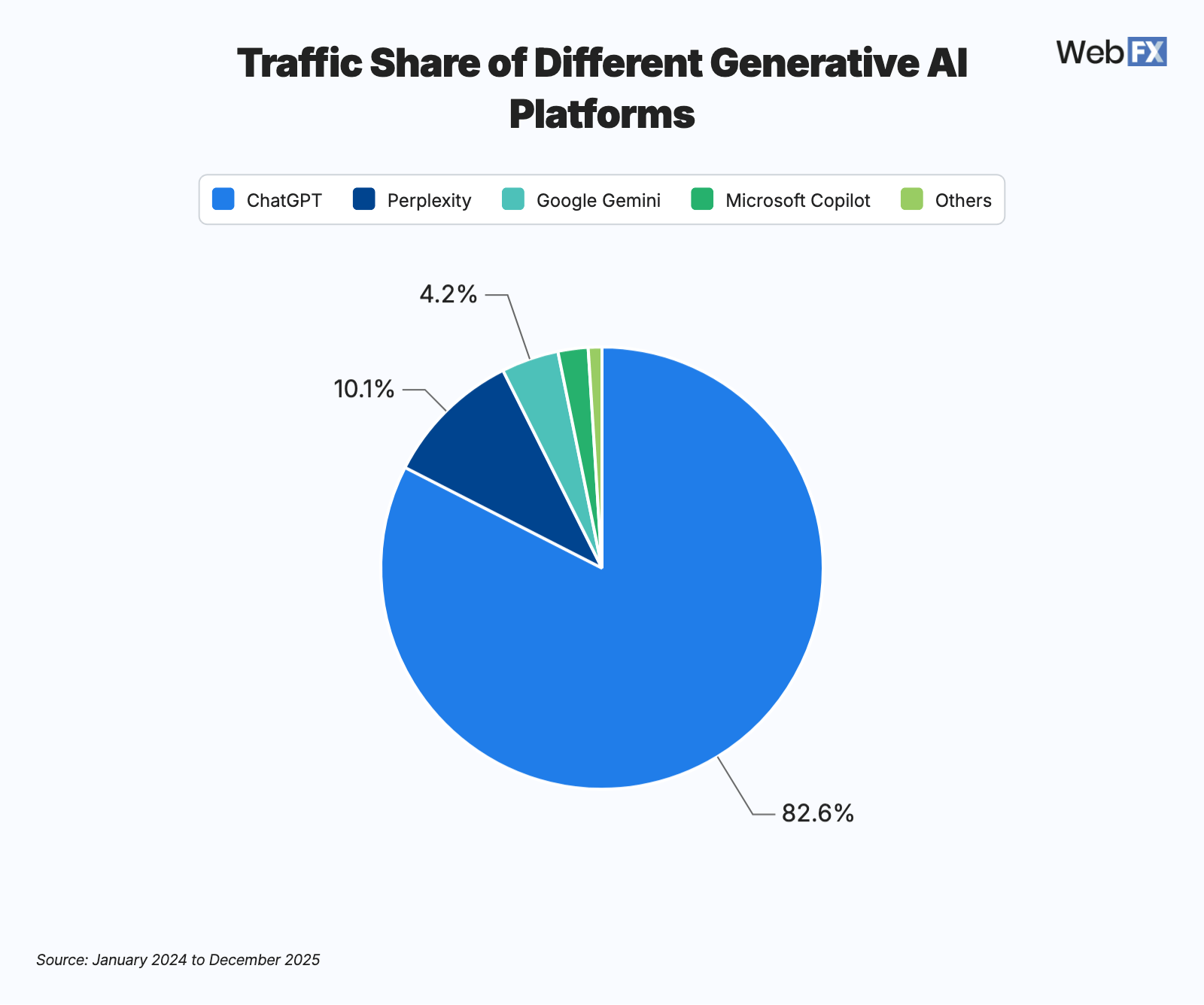
From 2024 to 2025, ChatGPT accounted for 82.6% of all generative AI traffic. The next-closest platforms — including Perplexity and Google Gemini — accounted for much smaller shares.
When combined, the top three AI platforms generated 96.9% of all AI-driven visits. In other words, AI discovery is not spread across dozens of tools. Instead, most AI discovery happens on just a few platforms.
For marketers, that concentration simplifies strategy. The same optimization principles apply across AI platforms — you must have authoritative content, clear explanations, structured information, and credible sources. When it comes to where your brand is most likely to appear in AI answers, though, ChatGPT currently dominates the landscape.
That doesn’t mean other platforms are irrelevant. Perplexity continues to serve research-heavy queries, and emerging assistants from Google and Microsoft are still evolving.
Focus on creating authoritative content that AI platforms can reference with confidence. Content like original research, expert explanations, and clear answers to questions for a specific audience can get you cited or referenced.
Ensure your pages are well-structured, too. This not only helps readers skim and better understand your content, but also helps crawlers find, extract, and cite it.
You don’t need to create different content for each AI tool. Build content strong enough that any AI system can rely on it.
Monitor emerging platforms without overinvesting
Perplexity, Gemini, and Copilot still contribute smaller shares of traffic today. Track their growth and monitor citations, but allocate resources proportionally to their current impact.
As generative AI evolves as a channel, the distribution may change.
AI adoption accelerated across B2B industries
Generative AI traffic growth in 2025 was not confined to SaaS or technology companies. Adoption accelerated across research-intensive B2B sectors.
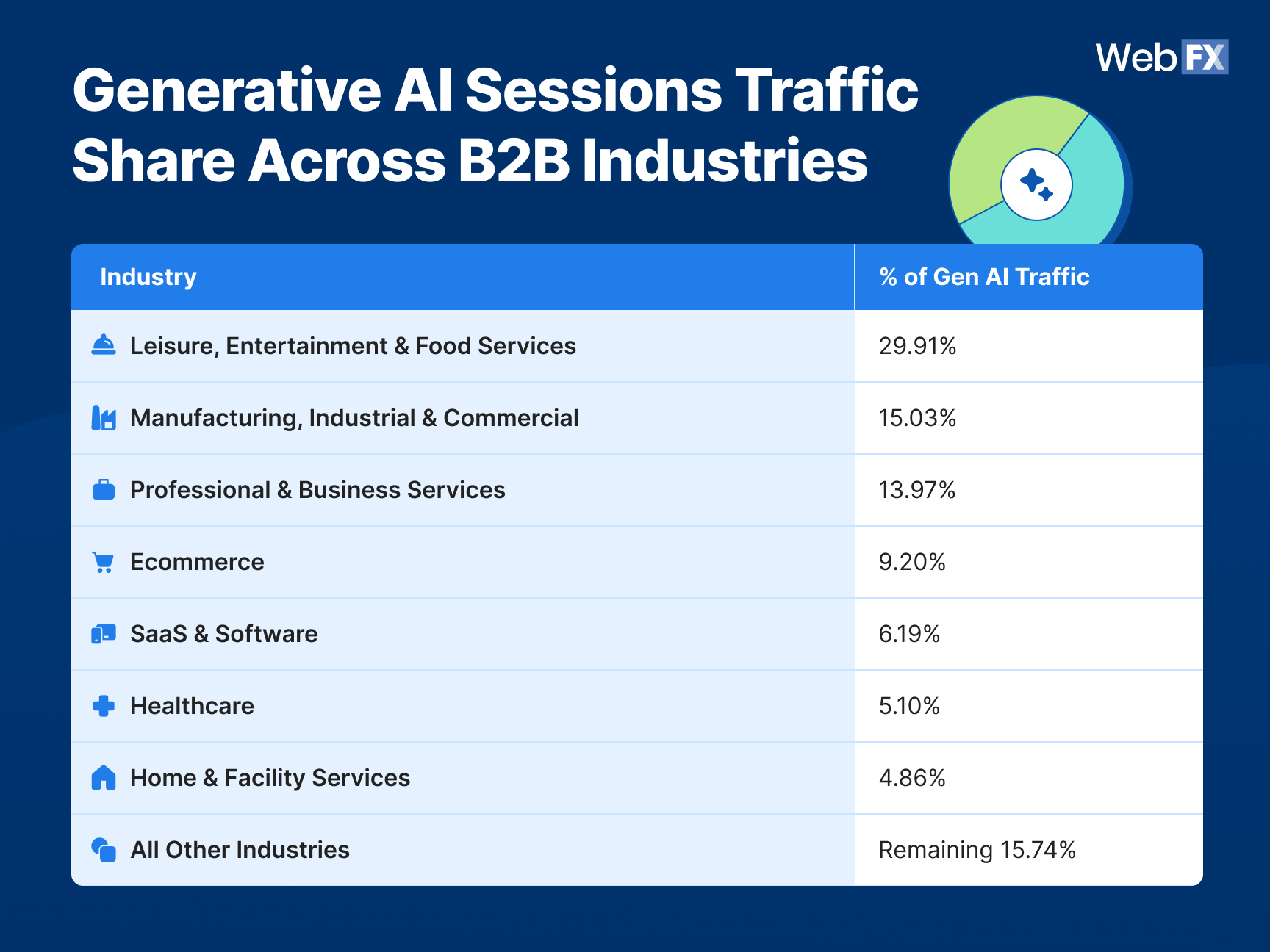
In our dataset, Manufacturing, Professional Services, and SaaS accounted for roughly 35% of generative AI traffic in 2025. These industries often require buyers to carefully compare options, validate capabilities, and align stakeholders before inquiring.
Manufacturing, Professional Services, and SaaS accounted for ~35% of generative AI traffic in 2025.
Generative AI Sessions Traffic Share Across B2B Industries
Industry
% of Gen AI Traffic
Leisure, Entertainment & Food Services
29.91%
Manufacturing, Industrial & Commercial
15.03%
Professional & Business Services
13.97%
Ecommerce
9.20%
SaaS & Software
6.19%
Healthcare
5.10%
Home & Facility Services
4.86%
All Other Industries
Remaining 15.74%
Manufacturing and Heavy Equipment showed sustained acceleration into late 2025, while Professional Services experienced an early-2025 surge followed by stabilization. As quarterly growth stabilized overall, these industries continued to see sustained increases in AI-referred sessions, showing us that technical buyers are incorporating AI tools into procurement workflows.
Home Services followed a different trajectory. AI traffic in this category moved from negligible volume in early 2024 to steady, conversion-producing streams by late 2025.
While total session share remained modest in Home Services, AI-assisted visits showed conversion activities, suggesting that AI platforms power vendor discovery and assist with initial outreach. Total session share in the SaaS and Software industry also appears small compared to other industries and is likely due to larger datasets coming from other B2B sectors.
2024-2025 Generative AI Traffic YoY Growth by Quarter of B2B Industries
Industry
Q1
Q2
Q3
Q4
Heavy Equipment
1,139%
1,211%
585%
255%
Manufacturing
1,114%
1,850%
817%
302%
Home Services
1,519%
3,057%
1,273%
543%
Professional Services
1,524%
1,900%
275%
115%
B2B buyers are shortlisting vendors before they visit your website
B2B buyers increasingly use AI platforms to compare vendors, review specifications, and narrow options before visiting company websites. By the time they visit your website, they are confirming details, not starting their research.
If your specifications, service descriptions, or case studies are not surfaced in AI-assisted research, buyers may never discover or consider your business. That makes visibility during their early comparison critical — vendors mentioned at this stage have a chance of getting evaluated.
Action items for B2B marketers: Improve your visibility in AI-assisted research
B2B buyers use AI platforms to gather, compare, and shortlist options before visiting vendors’ websites and inquiring. To get their attention at this stage, you must have structured, authoritative content.
Make product specifications, service packages, compliance details, and pricing models easy to find and easy to interpret.
Front-load key information at the top of your pages. In addition, ensure product specs and key details are consistent across pages so buyers and crawlers can easily find and understand them.
Structured data (or schema markup) won’t guarantee citations, but it helps crawlers extract and summarize your content accurately. For many B2B organizations, useful schema markups include:
Organization (brand identity signals)
Product or Service (offer details)
Offer (pricing and packaging structure when applicable)
FAQPage (common validation questions)
BreadcrumbList (site structure)
Use the types that match what you actually publish to make important details clear.
Keep product names, categories, and terminology consistent across pages. Doing so increases the likelihood that AI-generated summaries will reflect your correct offerings and details.
B2B buyers look for credibility signals, while AI-powered searches look for statements that they can reference. When applicable, incorporate insights from subject-matter experts, case studies, and data-backed comparisons into your content.
This generative engine optimization case study is one example of how expert-backed, proof-focused content can strengthen credibility and support visibility during AI-assisted research. The same principle applies across industries.
For example, a manufacturing supplier can publish an engineer-reviewed specification table comparing material tolerances, performance metrics, and compliance standards across product lines, along with a case study.
By providing specific, technical details, you’re improving both buyer trust and AI interpretability.
Regularly check how your B2B business appears for high-intent queries on leading AI platforms. OmniSEO® and other AI visibility tools can help streamline this process by monitoring, analyzing, and optimizing your presence on ChatGPT and other major AI search experiences.
Expert insights from
Sarah B.Lead Web Marketing Consultant
“A brand visibility audit is an ideal starting point because it helps you understand how your brand and its competitors appear in AI search experiences, whether as a mention, citation, or not at all.”
🎥Watch: Your AI Optimization Guide for Brand Visibility
How to optimize for AI visibility in 2026
Generative AI has not replaced traditional traffic channels, with direct and organic search still dominating with 35.51% and 27.12% of total sessions, respectively, in 2025. However, generative AI platforms are increasingly influencing how online users evaluate vendors and make purchase decisions.
For marketers, this means there are different ways for their prospects to discover their business. Appearing in traditional search results remains essential, but being mentioned in AI-generated answers is critical to getting noticed and shortlisted.
As earlier sections showed, the AI-referred visitors often arrive at your website ready to take action. Within Google’s AI Overviews specifically, AI Overview traffic quality data shows that daily users click cited sources 50% of the time, a 3.5x gap over occasional users, meaning the visitors who do click through are often among the highest-intent audience in your entire channel mix.
Instead of focusing only on session growth, monitor the quality of traffic arriving from different channels with metrics such as:
Conversion events per user
Assisted conversions
Engagement patterns
These metrics reveal which channels drive revenue, helping you identify the optimization efforts to prioritize.
2. Track generative AI visibility as a distinct channel
Create a separate reporting view for generative AI traffic in your analytics platform. As AI platforms become a measurable source of discovery, isolating that traffic makes it easier to evaluate their influence.
Monitor referral sources from major AI tools and compare how those visits behave compared to other channels. Over time, this analysis can reveal which pages, resources, and topics are most frequently surfaced in AI-generated responses.
3. Align SEO and GEO through a “double-dip” strategy
“Create clear, expert content that answers real customer questions, structure it so AI systems can easily understand it, and build authority around your core topics.”
Search engines still capture a large share of discovery traffic, while AI platforms increasingly shape how buyers validate their options during evaluation. Having a strong content strategy can support both your SEO and GEO efforts.
A strong content strategy can support both. “As research expands beyond traditional search, the brands that get cited will consistently provide the most helpful answers (backed by first-party data and experience) across discovery channels,” Emily explains.
SEO-focused content helps your brand appear during early research. The same pages — when structured clearly and supported with credible information — can become sources that AI systems can cite when users ask deeper questions.
This “double-dip” approach allows a single piece of content to contribute to both discovery and decision stages of the buyer journey. That’s the same conclusion our analysis of nearly 600,000 AI sessions reached: the content that earns AI traffic is overwhelmingly decision-stage, not top-of-funnel.
Show up in AI Search and Beyond
See how WebFX can help your brand increase visibility everywhere your audience is searching- from ChatGPT to Google and beyond.
Search behavior has evolved — so should your strategy
Traffic from generative AI has increased 796% from 2024 to 2025, with AI-driven visitors converting at about 1.2x the rate of organic search. No strategy or traffic channel is dying, though.
What we’re seeing is an evolution in how your prospects discover and shortlist their options. Staying visible in various channels, including emerging ones, is key to capturing and nurturing them.
Our AI SEO services help future-proof your search visibility, while OmniSEO® technology gives you the insights and tracking needed to measure performance across AI platforms. Combined with AI SEO services, OmniSEO® helps businesses understand and improve visibility wherever prospects search.
Craft a tailored online marketing strategy! Utilize our free Internet marketing calculator for a custom plan based on your location, reach, timeframe, and budget.
Craft a tailored online marketing strategy! Utilize our free Internet marketing calculator for a custom plan based on your location, reach, timeframe, and budget.









 Maria is a Lead Content Specialist at WebFX. With nearly two decades of experience in B2B and B2C publishing, marketing, and PR, she has authored hundreds of articles on digital marketing, AI, and SEO to help SMB marketers make informed strategic decisions. Maria has a degree in B.S. Development Communication major in Science Communication, and certifications in inbound marketing, content marketing, Google Analytics, and PR. When she’s not writing, you’ll find her playing with her dogs, running, swimming, or trying to love burpee broad jumps. View full profile