


Table of Contents
- Marketing agency comparison factors
- 1. Agency type
- 2. Services
- 3. Industry experience
- 4. Performance metrics
- 5. Pricing
- 6. Technology and reporting
- 7. Reviews and case studies
- 8. Communication fit
- Top marketing agencies by category
- Digital marketing agencies
- SEO agencies
- Content and social media agencies
- How to choose a marketing agency
- 1. Define your needs
- 2. Build your agency shortlist
- 3. Compare proof of performance
- 4. Request proposals
- 5. Review the contract
- FAQs about comparing marketing agencies
- Should I choose a specialist or a full-service agency?
- How many agencies should I compare before deciding?
- What should be included in the contract?
- How soon should I expect results from an agency?
- Compare marketing agencies with WebFX

How to compare marketing agencies
- Compare agency type, services, industry experience, pricing, reporting, and communication fit.
- Review performance metrics to see how each agency connects marketing work to business results.
- Use reviews, case studies, and proposals to compare proof of performance.
- Shortlist three to five agencies before choosing the best fit for your goals.
When you compare marketing agencies, focus on the factors that reveal fit and performance, such as agency type, services, industry experience, performance metrics, pricing, technology, reviews, and communication fit. These comparison points help you move beyond surface-level promises and choose an agency that can support your goals, budget, and growth plans.
In this guide, we’ll break down the top marketing agency comparison factors, share a short list of agencies to consider by category, and walk through the steps to choose the right partner for your business.
You can also use our marketing agency comparison checklist to evaluate each agency side by side and keep your research organized.
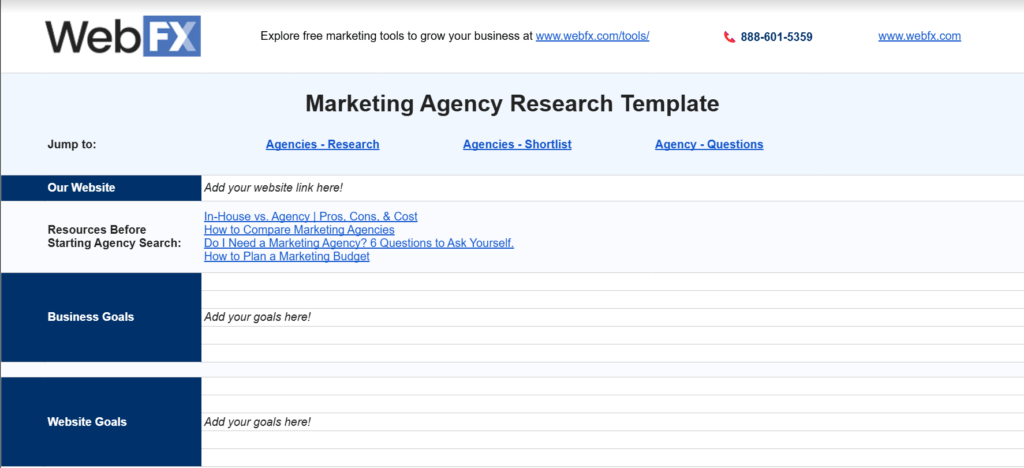
Download Now: Marketing Agency Research Template
Marketing agency comparison factors
Before you compare marketing agencies, you need a clear framework for evaluating each option. These factors help you compare agencies side by side instead of relying on general claims, sales decks, or one strong proposal call.
Use these eight comparison factors to understand what each agency offers, how they work, and how well they align with your goals.
- Agency type
- Services
- Industry experience
- Performance metrics
- Pricing
- Technology and reporting
- Reviews and case studies
- Communication fit
1. Agency type
Start by comparing the type of agency you need. Some agencies offer full-service support, while others specialize in one channel, service area, industry, or audience type.
A full-service agency is often a better fit if you want one partner to manage SEO, PPC, content marketing, social media, web design, and analytics. A specialized agency may work better if you only need support in one focused area, like paid advertising or technical SEO.
For example, a company that needs lead generation, website updates, reporting, and paid campaigns may benefit from a full-service agency because each channel can support the next. A company that already has an internal marketing team may only need a specialist to improve one underperforming channel.
2. Services
Review each agency’s service offerings to make sure they match your current needs and future goals. Most marketing agencies offer some mix of SEO, PPC, social media marketing, content marketing, email marketing, web design, analytics, or conversion rate optimization.
The key is choosing an agency that can support your next stage of growth — not just your immediate project.
For example, you may only need SEO help right now, but your strategy might require content creation, technical SEO fixes, CRO testing, or paid search support later. Choosing an agency with connected services can help you scale without restarting the vendor search every time your needs expand.
When comparing services, make sure you know exactly what each agency includes. “SEO services” could mean technical audits and content strategy at one agency, while another may only include basic keyword updates and monthly reports.
3. Industry experience
Look for agencies that understand your industry, audience, sales cycle, and competitive landscape. Industry experience helps an agency build strategies around the way your buyers actually search, compare, and convert.
For example, a B2B manufacturer with a long sales cycle needs a different strategy than an ecommerce company focused on fast product sales. A healthcare organization may need extra care around compliance-aware messaging, while a home services company may need a stronger local search and lead tracking strategy.
Industry experience does not mean an agency needs to work only in your niche. It means they should understand your market well enough to ask informed questions, identify the right channels, and explain how they will reach your audience.
4. Performance metrics
Compare how each agency measures success. Strong agencies should connect their work to metrics that matter to your business, like qualified leads, revenue, conversion rate, cost per lead, customer acquisition cost, and return on investment.
This factor helps you separate agencies that report activity from agencies that prove business impact.
For example, an agency may report that organic traffic increased 30%. That number is helpful, but it becomes more valuable when paired with lead quality, conversion rate, and revenue influenced by organic search.
Ask each agency which metrics they will track, how they define success, and how they will use performance data to adjust your strategy. The best answers should show how their work connects to your larger business goals.
5. Pricing
Compare each agency’s pricing model, included deliverables, and extra costs. Make sure you understand the monthly retainer, setup fees, ad spend requirements, software costs, contract length, and any fees for additional work.
A lower price does not always mean better value. The better comparison is what you get for the price and how clearly the agency ties that investment to your goals.
For example, one proposal may cost less because it includes fewer deliverables, less reporting, or limited strategy time. Another proposal may cost more but include deeper analytics, more content, dedicated specialists, and ongoing optimization.
To make pricing easier to compare, ask each agency for the same details:
- Monthly cost
- Setup or onboarding fees
- Included deliverables
- Contract length
- Reporting frequency
- Ad spend requirements
- Software or platform fees
- Cost for out-of-scope work
This process helps you compare value rather than just monthly prices.
Learn More: Marketing Agency Cost 2026
6. Technology and reporting
Review the technology each agency uses to plan, track, and report on your campaigns. The right tools should help you understand campaign performance, lead quality, and revenue impact.
Make sure each agency can explain how they track results, how often they report, and how they turn performance data into next-step recommendations.
For example, an agency may use analytics platforms, call tracking, customer relationship management tools, or proprietary marketing technology to connect campaign activity to real business outcomes. This reporting setup helps you see which channels generate leads and which leads become customers.
Best practice here is to ask for a sample report before signing. A strong report should explain what changed, why it changed, what the agency recommends next, and how the results connect to your goals.
7. Reviews and case studies
Use reviews and case studies to evaluate proof of performance. Reviews can show you what it feels like to work with the agency, while case studies show the types of results they have produced for other clients.
Look for patterns in the feedback. Strong signs include clear communication, measurable results, reliable project management, and experience with businesses similar to yours.
Case studies should also show context. A useful case study explains the client’s challenge, the strategy the agency used, and the results that followed. If an agency only shares broad claims without showing the strategy or outcome, ask for more detail during the proposal process.
See: WebFX’s 1,100+ Reviews and Testimonials
8. Communication fit
Compare how each agency communicates before you sign a contract. Ask who your main point of contact will be, how often you’ll meet, what reports you’ll receive, and how quickly they respond to questions.
Good communication fit keeps your campaigns moving because everyone knows what’s happening, what changed, and what needs to happen next.
For example, some businesses want weekly calls and detailed reporting. Others prefer a monthly strategy call with clear action items. Neither model is wrong — the best fit depends on how involved your team wants to be.
Before choosing an agency, make sure you understand:
- Who will manage your account
- How often you will meet
- How performance updates will be shared
- How approvals will work
- How the agency handles urgent requests
- How they communicate strategy changes
This comparison factor is especially important if your internal team is small or your leadership team expects regular updates.
Top marketing agencies by category
A short agency list can help you start your comparison process faster. Use these categories as a starting point, then compare each agency against your goals, budget, services, and preferred working style.
This section is not a full ranking of every agency available. Instead, it highlights a few safe starting points by category so you can begin your shortlist with agencies that already appear in WebFX agency resources.
| Category | Agency | Best for | Why compare this agency |
| Digital marketing | WebFX | Revenue generation and measurable results | Full-service support across SEO, PPC, content, social, web design, CRO, and OmniSEO. |
| The SEO Works | Companies looking for SEO specialists | Search-focused services with related digital marketing support. | |
| Strike Digital | Ecommerce revenue growth | Paid media support for ecommerce brands. | |
| SEO | WebFX | Full-service SEO with revenue tracking | SEO support tied to leads, revenue, reporting, and attribution. |
| The SEO Works | Dedicated SEO and digital PR support | SEO support with backlink and digital PR services. | |
| Seoplus+ | Improving organic visibility | SEO services with content and paid search flexibility. | |
| Content and social media | WebFX | Turnkey content marketing solutions | Content strategy, creation, SEO, analytics, and promotion in one place. |
| Atrium Digital | Micro-audience content | Content support for specific audience segments. | |
| Prohibition | PR-focused content | Content support for brand awareness and reputation. |
Digital marketing agencies
We chose the best digital marketing agencies based on service breadth, pricing visibility, verified ratings, and fit for businesses that need multi-channel support.
1. WebFX
Best for: Revenue generation and measurable results
WebFX is a strong fit for companies that want one full-service partner to support multiple digital marketing channels. With services like SEO, PPC, content marketing, social media, web design, CRO, and OmniSEO, WebFX works well for businesses that want connected campaigns and clearer revenue tracking.
This option is especially helpful if you want an agency that can manage strategy, execution, reporting, and optimization across multiple channels instead of splitting work between several vendors.
2. The SEO Works
Best for: Companies looking for SEO specialists
The SEO Works is a good fit for businesses that want digital marketing support with a stronger focus on SEO. Their services include SEO, PPC, web design, link building, and digital PR, which can work well for companies that need to improve search visibility while still supporting related digital channels.
This option may be a stronger fit if SEO is your main priority and you want an agency with search-focused service depth.
3. Strike Digital
Best for: Ecommerce revenue growth
Strike Digital is a strong option for ecommerce companies that want support with paid channels and revenue-focused campaigns. Their services include ecommerce marketing, social media ads, and paid search, making them a potential fit for brands that need to drive more online sales through advertising.
This agency may be a good starting point if your main goal is scaling ecommerce performance through paid media.
SEO agencies
We chose these top SEO agencies based on agencies that have good SEO service depth, pricing visibility, ranking recognition, and the ability to support measurable organic growth.
1. WebFX
Best for: Full-service SEO with revenue tracking
WebFX is a strong SEO agency option for businesses that want SEO connected to larger marketing and revenue goals. WebFX’s SEO services include technical SEO, content creation, on-page optimization, off-page brand authority, reporting, and revenue attribution.
This option works well if you want to improve rankings while also understanding how organic search contributes to leads, calls, sales, and revenue.
2. The SEO Works
Best for: Dedicated SEO and digital PR support
The SEO Works is a good fit for companies that want SEO support backed by related services like link building and digital PR. This combination can help businesses improve organic visibility while strengthening authority signals outside their website.
This agency may work well if your SEO strategy needs more support around backlinks, digital PR, and search-focused growth.
3. Seoplus+
Best for: Improving organic visibility
Seoplus+ is a good option for businesses that want to improve organic visibility with support from SEO, PPC, and content marketing services. Their service mix can help companies build a more complete search presence across organic and paid channels.
This agency may be a fit if you want SEO support but also want flexibility to connect your organic strategy with content and paid campaigns.
Content and social media agencies
These top content and social media agencies were chosen based on content strategy success, social media content capabilities, pricing visibility, and audience engagement support.
1. WebFX
Best for: Turnkey content marketing solutions
WebFX is a strong fit for companies that want content strategy, content creation, SEO, analytics, and promotion support under one roof. This approach can help businesses create content that supports search visibility, lead generation, social engagement, and long-term revenue growth.
This option works well if you want content to connect with a larger digital strategy instead of living as a standalone blog or social calendar.
2. Atrium Digital
Best for: Micro-audience content
Atrium Digital is a good fit for companies that want to create content for more specific audience segments. This kind of focus can help businesses speak more directly to niche buyers, customer groups, or decision-makers.
This agency may be a strong option if your content strategy needs more audience precision and targeted messaging.
3. Prohibition
Best for: PR-focused content
Prohibition is a good fit for brands that want content with a stronger public relations angle. PR-focused content can support brand awareness, media visibility, and thought leadership when paired with a clear distribution strategy.
This option may work well if your business wants content that supports both audience engagement and brand reputation.
How to choose a marketing agency
Once you know what to compare, the next step is turning your research into a decision. Use these steps to narrow your options, request the right information, and choose a marketing agency with a clear plan for helping you reach your goals.
- Define your needs
- Build your agency shortlist
- Compare proof of performance
- Request proposals
- Review the contract
1. Define your needs
Start by outlining what you need from an agency. This step gives your comparison process structure and helps each agency recommend the right strategy.
Define your:
- Business goals
- Marketing goals
- Monthly or annual budget
- Must-have services
- Nice-to-have services
- Timeline
- Internal resources
- Success metrics
For example, your main goal may be increasing qualified leads from organic search. In that case, you may need SEO, content marketing, technical SEO, conversion tracking, and lead quality reporting.
When you define your needs first, you can avoid comparing agencies based on services that do not matter to your business.
If you want a more structured process for working through those criteria, our guide on how to choose marketing vendors walks through five steps — from goal-setting and budget confirmation to shortlisting candidates and reviewing service agreements.
2. Build your agency shortlist
Next, create a shortlist of agencies that match your needs. A good shortlist gives you enough options to compare without making the decision process too complicated.
Best practice is to compare three to five agencies. This range gives you a better sense of pricing, deliverables, strategy, and communication style without creating too many proposal calls for your team.
You can build your shortlist using:
- Google searches
- Clutch or G2 reviews
- WebFX agency comparison resources
- Referrals from trusted contacts
- LinkedIn research
- Case studies and portfolio pages
- Industry-specific agency lists
As you research, remove agencies that do not offer your must-have services, work with your type of business, or provide enough proof to support their claims.
3. Compare proof of performance
After you build your shortlist, compare each agency’s proof of performance. This step helps you evaluate whether the agency has done the kind of work you need.
Review their case studies, testimonials, ratings, portfolio examples, industry experience, and reporting samples. Make sure the examples connect to your goals.
For example, if you need more qualified leads, look for case studies that mention lead growth, conversion rate improvements, cost per lead, or revenue impact. If you need brand awareness, look for examples that show audience growth, engagement, visibility, or share of voice.
Make sure you also ask how recent the examples are. A case study from several years ago can still show expertise, but recent examples give you a better look at how the agency approaches current search, advertising, and content trends.
4. Request proposals
Request proposals from the agencies that make your final shortlist. To compare them fairly, give every agency the same background information and ask for the same proposal details.
Your request should include:
- Your goals
- Your target audience
- Your current marketing channels
- Your budget range
- Your biggest challenges
- Your preferred timeline
- Your must-have services
- Your reporting expectations
Then, ask each agency to include:
- Recommended strategy
- Included deliverables
- Pricing
- Timeline
- Team structure
- Reporting cadence
- Expected client involvement
- Contract terms
This process makes it easier to spot differences between agencies. For example, one agency may recommend a lower-cost plan but include fewer deliverables, while another may include more strategy, reporting, and optimization support.
5. Review the contract
Before you choose an agency, review the contract carefully. The contract should clearly explain what the agency will do, what you will pay, how long the agreement lasts, and what happens if your needs change.
Make sure the contract includes:
- Scope of work
- Deliverables
- Pricing
- Payment schedule
- Campaign timelines
- Reporting expectations
- Asset ownership
- Approval process
- Cancellation terms
- Renewal terms
- Extra fees
This step helps you avoid confusion after the partnership begins. It also gives your internal team a clear reference point for what the agency is responsible for delivering.
If anything feels unclear, ask for clarification before signing. A reliable agency should be able to explain the contract in straightforward terms and help you understand what is included.
FAQs about comparing marketing agencies
Should I choose a specialist or a full-service agency?
Choose a specialist if you need deep support in one channel, like SEO, PPC, or social media. Choose a full-service agency if your goals depend on multiple connected channels, such as search, paid ads, content, web design, analytics, and conversion rate optimization working together.
For example, a specialist may be the right fit if your internal team already manages most of your marketing and only needs expert support for one channel. A full-service agency may be the better fit if your team needs strategy, execution, reporting, and optimization across several channels.
The best choice depends on your goals, internal bandwidth, and how much coordination you want your agency to manage.
How many agencies should I compare before deciding?
Compare at least three agencies before deciding. Three options usually give you enough information to understand pricing, deliverables, communication styles, and strategy differences without making the process harder to manage.
If your project is larger or more complex, you may want to compare four or five agencies. For example, a company looking for SEO, PPC, content, web design, and analytics support may need a larger shortlist than a company looking for one focused service.
The goal is not to review as many agencies as possible. The goal is to compare enough qualified options to make a confident decision.
What should be included in the contract?
A marketing agency contract should include the scope of work, deliverables, pricing, payment schedule, campaign timelines, reporting expectations, asset ownership, cancellation terms, renewal terms, and any extra fees.
The contract should also explain how approvals work, who owns creative assets, and what happens if your business needs additional services. These details help both teams understand responsibilities before work begins.
If a proposal sounds strong but the contract lacks detail, ask the agency to clarify the terms in writing. Clear documentation helps your partnership start with the right expectations.
How soon should I expect results from an agency?
Your timeline depends on the services you choose. PPC and paid social can generate earlier data because campaigns launch quickly, while SEO and content marketing usually take longer because they rely on indexing, rankings, authority, and ongoing optimization.
For paid campaigns, you may start seeing initial performance data within the first few weeks. For SEO and content, you should expect a longer ramp-up period as the agency audits your site, makes improvements, publishes content, and monitors ranking changes.
A strong agency should set expectations before work begins. They should also explain what early progress looks like, what milestones they will track, and how they will adjust your strategy over time.
Compare marketing agencies with WebFX
Comparing marketing agencies takes time, but the right framework makes the process easier. When you review each agency’s services, experience, metrics, pricing, technology, proof, and communication style, you can choose a partner that fits your goals instead of relying on guesswork.
If WebFX is on your shortlist, you can compare us by the same standards. With full-service digital marketing capabilities, revenue-focused reporting, proprietary technology, and a team built to support long-term growth, WebFX can help you turn your marketing investment into measurable business impact.
Ready to see how WebFX compares? Contact us online or call 888-601-5359 today to speak with a strategist about your goals.
-
 Savannah is a content marketer with editorial experience spanning several businesses. Specializing in social media and marketing trends, she loves talking about the latest developments in online marketing. When she’s not writing, Savannah loves traveling, hoarding books and coffee mugs, and adoring her cat. Please don’t ask her about famous true crime cases, or else she’ll tell you all about her theories and get absolutely no work done. View full profile
 -

WebFX is a full-service digital marketing agency delivering revenue-driving strategies across online advertising, SEO and AI search optimization, and digital marketing. Backed by 1,100+ client reviews, a 4.9-star rating on Clutch, and proprietary revenue-tracking technology, our team helps businesses grow visibility and revenue across platforms, from Google to ChatGPT to LinkedIn. Discover how our expert team and revenue-accelerating tech can drive results for you. Learn more
Try our free Marketing Calculator
Craft a tailored online marketing strategy! Utilize our free Internet marketing calculator for a custom plan based on your location, reach, timeframe, and budget.
Plan Your Marketing Budget
Table of Contents
- Marketing agency comparison factors
- 1. Agency type
- 2. Services
- 3. Industry experience
- 4. Performance metrics
- 5. Pricing
- 6. Technology and reporting
- 7. Reviews and case studies
- 8. Communication fit
- Top marketing agencies by category
- Digital marketing agencies
- SEO agencies
- Content and social media agencies
- How to choose a marketing agency
- 1. Define your needs
- 2. Build your agency shortlist
- 3. Compare proof of performance
- 4. Request proposals
- 5. Review the contract
- FAQs about comparing marketing agencies
- Should I choose a specialist or a full-service agency?
- How many agencies should I compare before deciding?
- What should be included in the contract?
- How soon should I expect results from an agency?
- Compare marketing agencies with WebFX
Share this article


Proven Marketing Strategies
Try our free Marketing Calculator
Craft a tailored online marketing strategy! Utilize our free Internet marketing calculator for a custom plan based on your location, reach, timeframe, and budget.
Plan Your Marketing Budget
What to read next