


Fast facts: AI Overviews in healthcare
- 51% of health-related queries trigger AI Overviews: Over half of your potential patients may never visit your site. If your hospital, practice, or clinic isn’t cited in AI Overviews, you’re invisible at the top of the funnel.
- 66.9% of informational queries surface AI Overviews: Educational content like “does ear infection cause headache” is being summarized first. To get cited, prioritize medically reviewed, plain-language content with strong structure and credibility markers.
- 73.9% of long-tail queries (7+ words) trigger AI Overviews: These in-depth searches signal high intent and trust in AI-generated answers. Creating specific, FAQ-rich pages that reflect real patient questions is key to visibility.
Think your healthcare content is optimized for search? Think again. Google’s AI Overviews is reshaping the search space, and for healthcare, the shift isn’t subtle. It’s seismic.
In 2024, Google introduced AI Overviews directly into its search engine results pages (SERPs), surfacing concise summaries for users without requiring a click. While every industry felt the tremor, one vertical saw the ground move more than any other: Healthcare.
In our analysis of over 130,000 health-related search queries, we found that AI Overviews now appear in 51% of healthcare searches. That’s double the average across all industries.
That means when someone searches for symptoms, treatment options, dietary advice, or diagnostic terms, there’s a good chance they’ll see Google’s AI Overviews answering the question first before your content even has a chance.
For digital marketers, healthcare content teams, and anyone affected by generative AI in healthcare marketing, this poses an urgent question: How do you even stay visible in a world where Google answers for you?
In this breakdown, we’ll walk you through:
- Why healthcare tops all industries for AI overviews
- Which query patterns put healthcare content in the danger zone
- How local and brand modifiers protect healthcare searches
- What healthcare marketers need to do right now to adapt
Why healthcare tops all industries for AI overviews

1 in 2 health-related searches now displays an AI Overview box.
Healthcare is the epicenter of Google’s AI Overview rollout, and the numbers prove it.
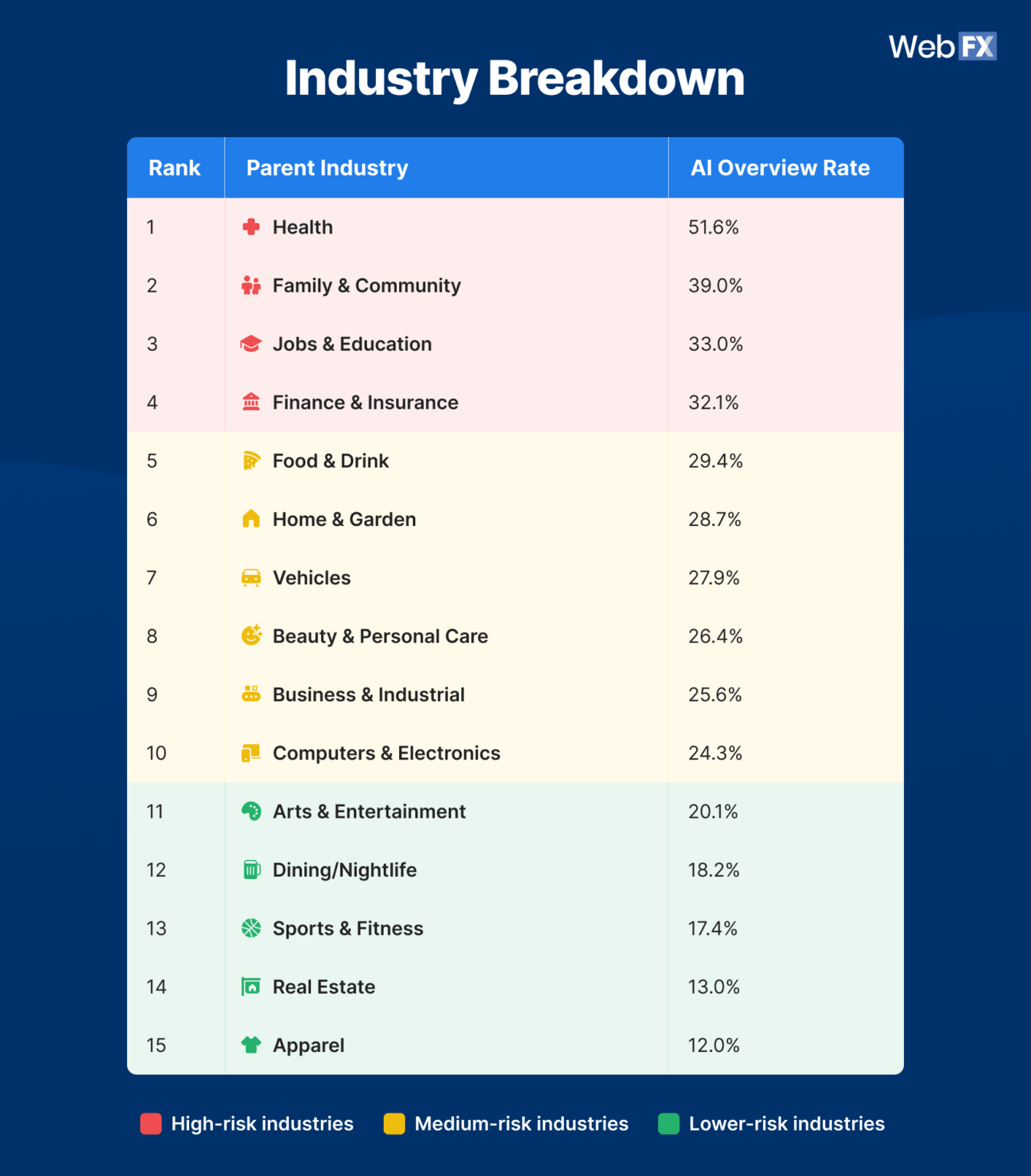
In our broader analysis of 2.37 million U.S. search queries, health-related searches had the highest AI Overview rate of any industry (51.6%). For a broader look at how these and other shifts are reshaping the healthcare landscape, our 2026 healthcare industry trends report covers the key developments marketers and providers need to know.
AI Overview rates by industry
🔽 Table View
| Rank | Industry | AI Overview Rate |
|---|---|---|
| 1 | Health | 51.6% |
| 2 | Family & Community | 39.0% |
| 3 | Jobs & Education | 33.0% |
| 4 | Finance & Insurance | 32.1% |
| 5 | Food & Drink | 29.4% |
| 6 | Home & Garden | 28.7% |
| 7 | Vehicles | 27.9% |
| 8 | Beauty & Personal Care | 26.4% |
| 9 | Business & Industrial | 25.6% |
| 10 | Computers & Electronics | 24.3% |
| 11 | Arts & Entertainment | 20.1% |
| 12 | Dining / Nightlife | 18.2% |
| 13 | Sports & Fitness | 17.4% |
| 14 | Real Estate | 13.0% |
| 15 | Apparel | 12.0% |
To deepen that finding, we also ran a focused study of 130,070 health-related queries, where AI Overviews appeared in 51% of searches. This reinforces the industry’s outsized exposure to AI-generated answers across the board.
Bottom line: Healthcare is ground zero for AI Overviews.
Why is healthcare at the top?
Google has made one thing clear: AI Overviews are built to provide fast, reliable answers for complex queries. Healthcare checks every box:
- High trust threshold: Users expect accurate and reputable sources when searching for health information. Google elevates authoritative answers quickly.
- Educational search behavior: Many healthcare queries are informational in nature (e.g., symptom explainers, treatment comparisons).
- Life-impacting outcomes: When the stakes are high, like understanding a potential diagnosis, Google prioritizes instant clarity through generative AI in healthcare SERPs.
For marketers in the health space, this shift marks a pivotal change in how patients discover information. Pages that once generated thousands of visits for condition overviews or “what is” articles may now compete directly with AI-generated summaries.
Which query patterns put healthcare content in the danger zone
When it comes to AI Overviews in healthcare, not all queries are treated equally. Some get bypassed entirely. Others are prime real estate for Google’s generative AI to step in and answer before a user ever clicks through to your site.
What triggers AI Overviews in healthcare?
Our data reveals that two factors skyrocket the chances of your content being superseded by AI Overviews:
| Factor | What it signals | How it triggers AI Overviews |
|---|---|---|
| Query length | The number of words in a search query. | Longer queries (7+ words) have a much higher chance of triggering AI Overviews (up to 73.9% in healthcare). |
| Search intent | The reason behind the search. Is the user looking for information, a product, or a brand? | Informational queries are hit hardest, with 66.9% triggering AI Overviews. |
Long queries = high AI risk
Healthcare queries that are 7+ words long trigger AI Overviews nearly three out of four times (73.9%).
That’s a massive leap from the 1–2 word range, where AI Overviews appear in 35.8% of health-related searches. In short, the more specific and educational your content, the more likely it is to be preempted by Google’s AI.
Here’s how likely AI Overviews get triggered depending on the length of health queries:
| Query length | AI Overview rate | Query count |
|---|---|---|
| 1–2 words | 35.8% | 28,465 |
| 3–4 words | 50.5% | 68,365 |
| 5–6 words | 63.0% | 26,298 |
| 7+ words | 73.9% | 6,942 |
Long-form queries (which traditionally signal high intent and informational value) are now deep in the AI danger zone. That “how-to” blog post you’ve optimized? Google might summarize it before the user ever gets to you.
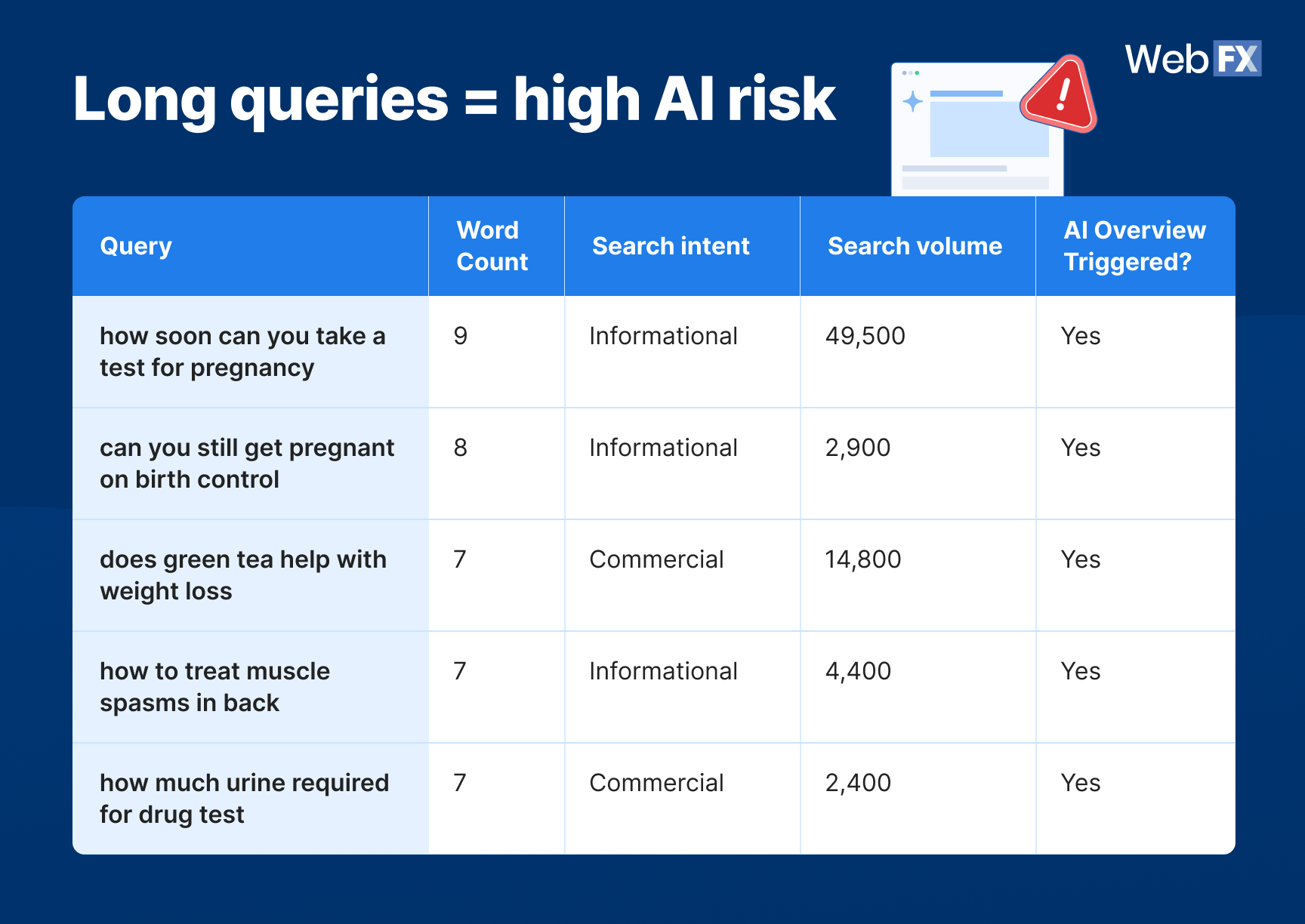
Real examples from our dataset
🔽 Table View
| Query | Word Count | Search intent | Search volume | AI Overview Triggered? |
|---|---|---|---|---|
| how soon can you take a test for pregnancy | 9 | Informational | 49,500 | Yes |
| can you still get pregnant on birth control | 8 | Informational | 2,900 | Yes |
| does green tea help with weight loss | 7 | Commercial | 14,800 | Yes |
| how to treat muscle spasms in back | 7 | Informational | 4,400 | Yes |
| how much urine required for drug test | 7 | Commercial | 2,400 | Yes |
These aren’t fringe topics. They’re high-volume, health-sensitive queries where AI in the medical field is stepping in with answers at the top of the SERP.
Informational intent gets hit hardest
AI Overviews don’t just follow query length. They also chase search intent. And in healthcare, informational searches are the most vulnerable by far.
| Search intent | AI Overview rate | Query count |
|---|---|---|
| Informational | 66.9% | 71,252 |
| Commercial | 45.4% | 21,948 |
| Transactional | 35.3% | 16,698 |
| Navigational | 14.1% | 20,045 |
Google seems to be drawing a line:
- Informational = AI Overviews handles it
- Navigational/transactional = Let the SERP surface brands, maps, or ads
Real examples of high-risk informational queries
| Query | Word count | Search intent | Search volume | AI Overview Triggered? |
|---|---|---|---|---|
| does ear infection cause headache | 5 | Informational | 5,400 | Yes |
| thyroid normal values | 3 | Informational | 6,600 | Yes |
| what is an emergency medical technician | 6 | Informational | 8,100 | Yes |
| types of fats in the body | 6 | Informational | 2,400 | Yes |
These aren’t fringe topics. They’re high-volume, health-sensitive queries where AI in the medical field is stepping in with answers at the top of the SERP.
Informational intent gets hit hardest
AI Overviews don’t just follow query length. They also chase search intent. And in healthcare, informational searches are the most vulnerable by far.
| Search intent | AI Overview rate | Query count |
|---|---|---|
| Informational | 66.9% | 71,252 |
| Commercial | 45.4% | 21,948 |
| Transactional | 35.3% | 16,698 |
| Navigational | 14.1% | 20,045 |
Google seems to be drawing a line:
- Informational = AI Overviews handles it
- Navigational/transactional = Let the SERP surface brands, maps, or ads
Real examples of high-risk informational queries
| Query | Word count | Search intent | Search volume | AI Overview Triggered? |
|---|---|---|---|---|
| does ear infection cause headache | 5 | Informational | 5,400 | Yes |
| thyroid normal values | 3 | Informational | 6,600 | Yes |
| what is an emergency medical technician | 6 | Informational | 8,100 | Yes |
| types of fats in the body | 6 | Informational | 2,400 | Yes |
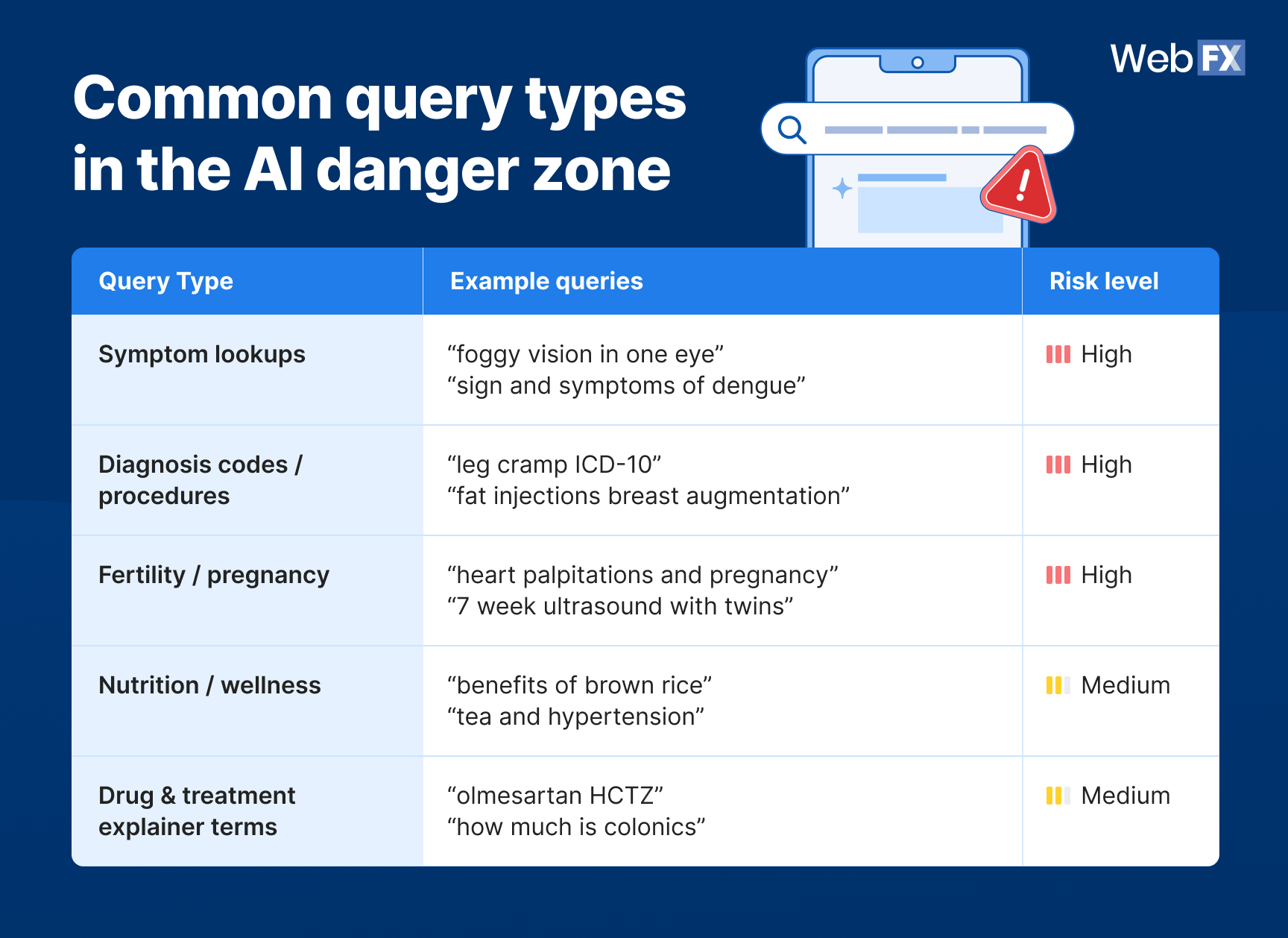
Common query types in the AI danger zone
Let’s call it what it is: Certain archetypes of healthcare content are sitting ducks for AI Overviews.
Here are the ones getting hit the hardest:
🔽 Table View
Query Type
Example queries
Risk level
Symptom lookups
“foggy vision in one eye”
“sign and symptoms of dengue”High
Diagnosis codes / procedures
“leg cramp ICD-10”
“fat injections breast augmentation”High
Fertility / pregnancy
“heart palpitations and pregnancy”
“7 week ultrasound with twins”High
Nutrition / wellness
“benefits of brown rice”
“tea and hypertension”Medium
Drug & treatment explainer terms
“olmesartan HCTZ”
“how much is colonics”Medium
Lifestyle tips
“how much juice in half lemon”
“gout food not to eat”Medium
Many of these were top performers for content marketing in previous years. But in today’s SERPs, they’re the ones most often answered by generative AI in healthcare.
AI Overviews in healthcare aren’t replacing all queries, but they’re consistently claiming the most educational, trust-heavy, and SEO-optimized ones. Hence, if your content portfolio is heavy on:
- “What is…” and “How to…” explainer articles
- Symptom guides and patient FAQs
- Comparison content (treatment types, vitamins, wellness plans)
…then you’re competing directly with AI for SERP visibility.
How local and brand modifiers protect healthcare searches
Not all healthcare queries are equally exposed to AI Overviews. In fact, some types of searches (particularly those with local or branded modifiers) are significantly less likely to trigger AI-generated summaries.
That’s good news for healthcare organizations focusing on brand authority, local SEO, or bottom-of-funnel content. These search types still depend on clicks, making them vital strongholds for organic visibility.
Comparing traffic, impressions, and click-through rates across these search types can help marketers determine whether AI search is hurting their traffic and identify where AI-generated results may be intercepting clicks.
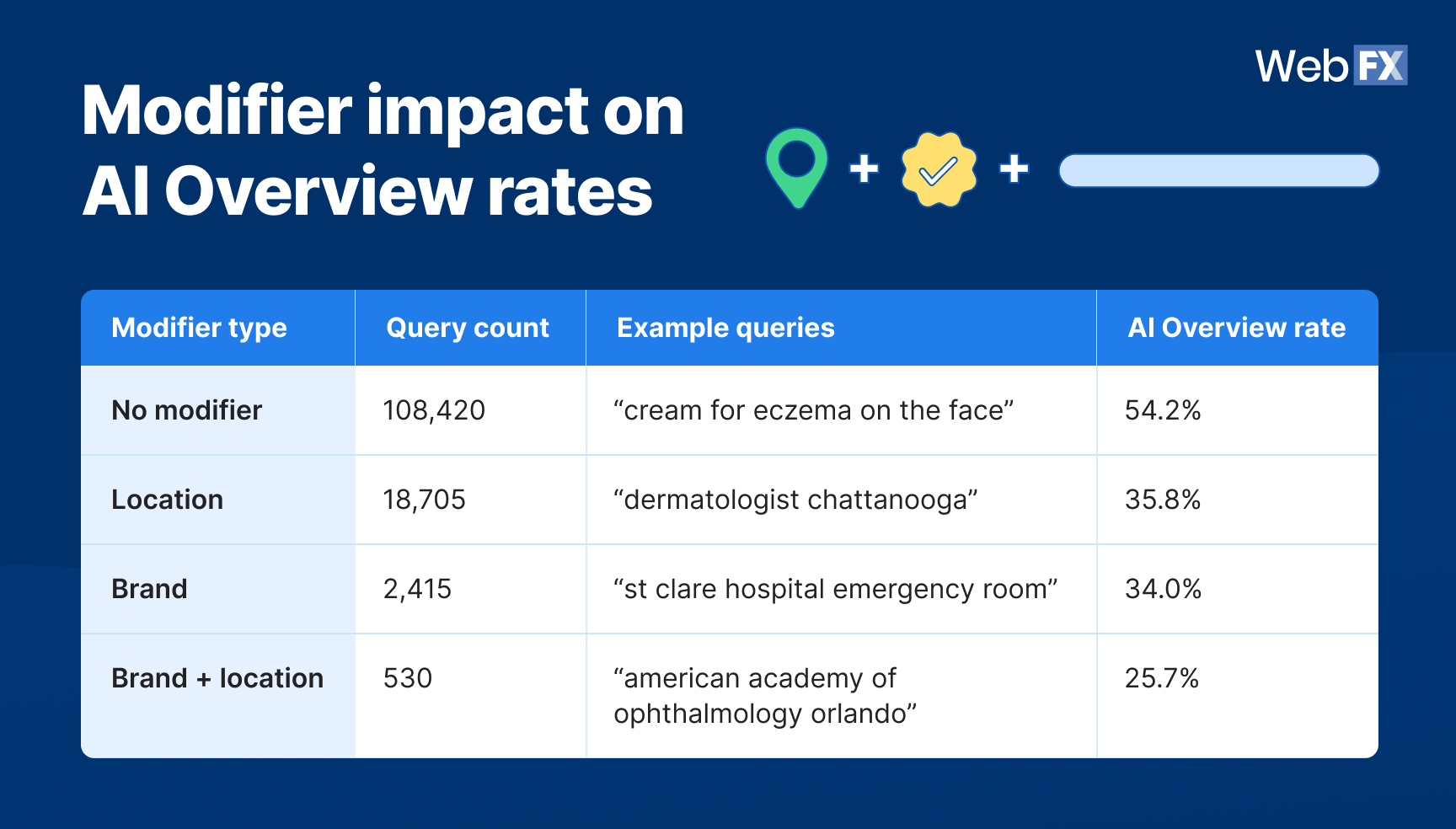
Modifier impact on AI Overview rates
In our health-specific dataset of 130,070 queries, here’s how different modifier types affect the likelihood of triggering an AI Overview:
🔽 Table View
| Modifier type | Query count | Example queries | AI Overview rate |
|---|---|---|---|
| No modifier | 108,420 | “cream for eczema on the face” | 54.2% |
| Location | 18,705 | “dermatologist chattanooga” | 35.8% |
| Brand | 2,415 | “st clare hospital emergency room” | 34.0% |
| Brand + location | 530 | “american academy of ophthalmology orlando” | 25.7% |
Therefore, adding brand or location to your content helps avoid zero-click exposure and keeps users engaged with your actual site.
Why these modifiers matter
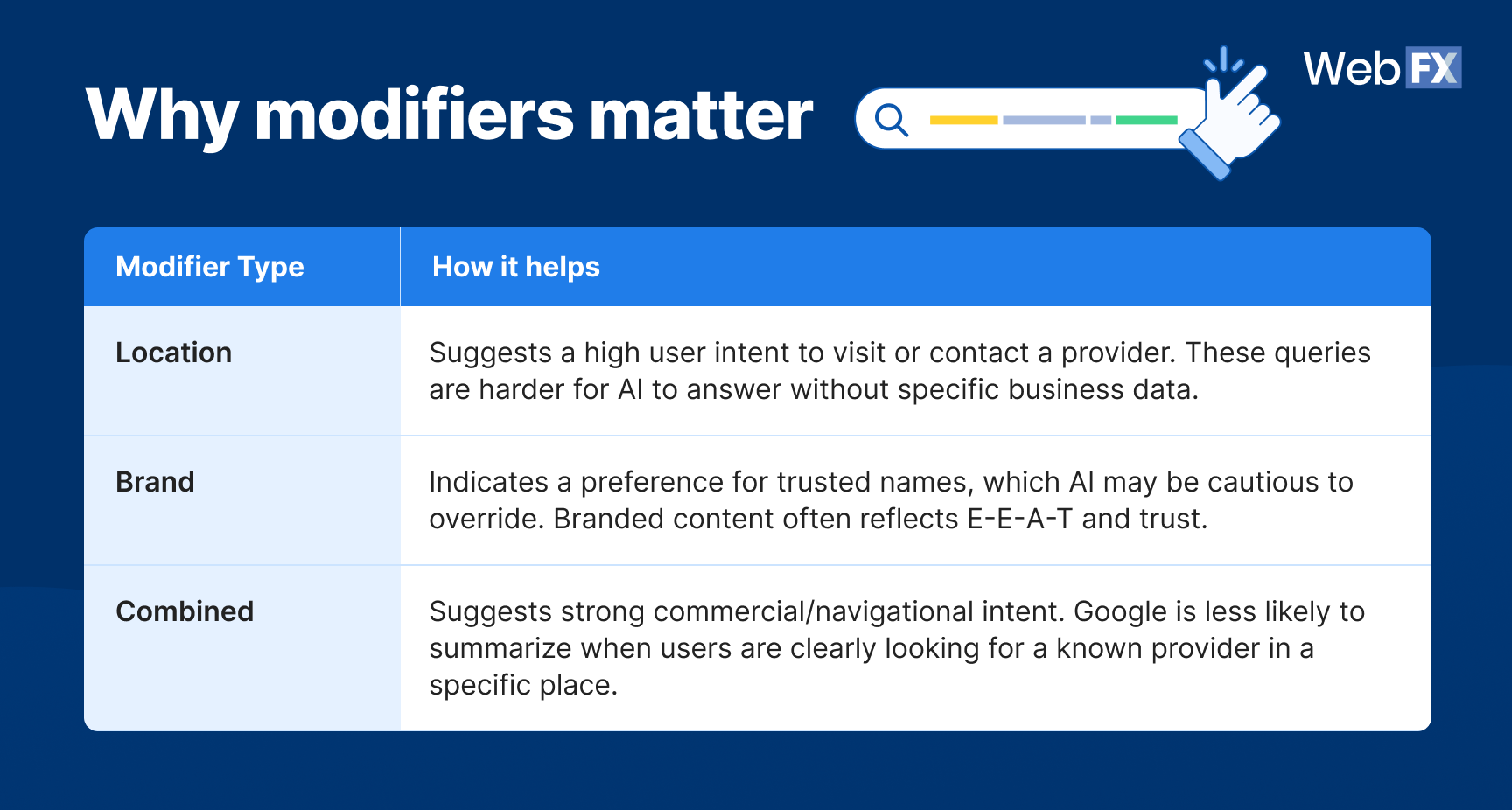
Modifiers like brand names and locations are game-changers (not just extra words). They add intent, signal trust, and help your content dodge the AI Overview trap. Here’s why each one gives you an edge:
🔽 Table View
| Modifier Type | How it helps |
|---|---|
| Location | Suggests a high user intent to visit or contact a provider. These queries are harder for AI to answer without specific business data. |
| Brand | Indicates a preference for trusted names, which AI may be cautious to override. Branded content often reflects E-E-A-T and trust. |
| Combined | Suggests strong commercial/navigational intent. Google is less likely to summarize when users are clearly looking for a known provider in a specific place. |
Not optimizing for branded and local queries means letting AI Overviews answer for you. If your current strategy leans heavily on general informational content, it may be time to expand your footprint with:
- Location pages optimized for high-intent searches (e.g., “urgent care near [city]”)
- Branded FAQs (e.g., “How does [Your Clinic] treat migraines?”)
- Navigational blog content (e.g., “What makes [Brand]’s approach to weight loss unique?”)
What healthcare marketers need to do right now to adapt
Google’s AI Overviews are rewriting the rules of health search (and patient journeys along with it). If your content isn’t built to stand out in this new landscape, you’re not just invisible, you’re irrelevant.
Here’s how healthcare marketers can adapt now to stay discoverable, trusted, and top-of-mind:
1. Double down on content quality and credibility
E-E-A-T (Experience, Expertise, Authoritativeness, Trustworthiness) isn’t optional in healthcare. It’s table stakes. AI Overviews are pulling answers from sites that demonstrate clear expertise and trust. That means:
- Publishing content written or reviewed by medical professionals
- Citing reputable sources (Mayo Clinic, NIH, peer-reviewed journals)
- Including clear author bios, medical disclaimers, and content review dates
In our dataset, health queries with medical brand and location modifiers were less likely to trigger AI Overviews, suggesting Google’s AI favors independent, authoritative sources over brand-biased content.
2. Lean into long-tail, question-based content
The data is clear: longer, more specific queries are more likely to trigger AI Overviews. Healthcare marketers should pivot toward:
- Answering patient questions clearly and concisely
- Structuring content with FAQs, headings, and schema
- Using long-tail keywords, conversational phrases, and natural language
Queries with 7+ words had a 73.9% AI Overview rate (the highest of any query length).
3. Don’t abandon your brand strategy (local and branded search still matter)
Even though brand + location queries are less likely to appear in AI Overviews, they signal strong intent. And these searchers still see traditional results and map packs. Your next steps:
- Optimize for branded search (e.g., “St. Clare Hospital cardiologist”)
- Maintain local SEO health (GBP, citations, local landing pages)
- Run branded paid search to protect your name and drive click-through
4. Experiment with structured data and AI-friendly formatting
Make your content easier for Google’s AI to summarize:
- Use short, punchy sentences
- Add bullets, numbered lists, and direct answers
- Implement schema markup (FAQPage, MedicalCondition, etc.) wherever relevant
5. Keep testing and tracking your AI visibility
Use tools like Semrush, Ahrefs, Google Analytics 4 (GA4), or Google Search Console to track your AI visibility, especially how often your pages appear in AI Overviews. Combine this with:
- Branded vs. non-branded traffic shifts
- Click-through rate (CTR) changes in high-AI verticals
- Featured snippet and People Also Ask (PAA) performance over time
FAQs about AI Overviews in healthcare
What are AI Overviews in healthcare, and why should marketers care?
AI Overviews are Google’s generative summaries that appear at the top of search results. In healthcare, they often pull content from multiple websites to answer complex medical questions. For marketers, this changes the game: Your content could be summarized without attribution or bypassed entirely. If you’re not optimized for AI, you’re missing out on visibility and trust when patients are actively searching for help.
How does generative AI in healthcare impact medical content strategy?
Generative AI in healthcare reshapes how patients access information. Instead of clicking links, users now get AI-curated summaries that synthesize data across multiple sources. For healthcare marketers, this means doubling down on high-quality, fact-checked, and well-structured content that AI sees as trustworthy. Clear answers, schema markup, and expert-reviewed content are now essential to stay competitive in the AI-driven SERP landscape.
Which types of healthcare queries are most likely to trigger AI Overviews?
Based on our dataset of 130,000+ queries, long-tail keywords, question-based searches like “does ear infection cause headache” or “how soon can you take a test for pregnancy” are most likely to show AI Overviews.
In contrast, branded or local queries like “dermatologist chattanooga” or “st clare hospital emergency room” are less likely to trigger them. Understanding these patterns helps shape smarter, AI-proof content strategies.
Is AI in healthcare marketing good or bad for visibility?
It depends on your approach. AI in healthcare marketing can boost visibility if your content is clear, expert-led, and structurally optimized for machine summarization. But if you’re relying on thin, generic content (or ignoring E-E-A-T principles), you risk being filtered out by Google’s AI. It’s not about beating the AI; it’s about being the source it trusts.
How can healthcare brands protect their visibility in an AI-first search world?
You can’t opt out of AI Overviews, but you can opt into relevance by:
- Creating branded and local content that resists AI summarization
- Structuring pages with questions, answers, and schema markups
- Building trust through credentials, citations, and clarity
- Monitoring AI visibility with tools like Semrush, Ahrefs, Google Analytics 4 (GA4), or Google Search Console
In short, don’t abandon SEO, evolve it for AI.
What’s the future of AI in the medical field from a content perspective?
AI in the medical field will keep pushing toward instant, trustworthy answers, and your content needs to keep up. Expect Google’s AI Overviews to favor sources with medical expertise, clarity, and low bias. That means healthcare brands must continuously update, fact-check, and structure content to remain a go-to source for both humans and machines.
Does AI-generated content perform well in healthcare marketing?
Not on its own. In healthcare content marketing, AI-generated content must be fact-checked, medically reviewed, and aligned with E-E-A-T. Google penalizes low-quality, auto-generated copy, especially in the medical field, where misinformation can cause real harm. Use generative AI in healthcare as a tool, not a replacement for human expertise.
Should healthcare marketers still invest in traditional SEO if AI Overviews dominate the SERPs?
Absolutely. Even with AI Overviews in healthcare, traditional SEO remains critical. Here’s why:
- Not all queries trigger AI, especially commercial, local, or branded ones
- Featured snippets, local packs, and organic listings still drive valuable clicks
- Strong SEO supports content that AI Overviews pull from in the first place
Think of SEO as your foundation. Generative AI in healthcare is just the next layer, not a substitute.
Your expertise deserves to be seen. Let’s make sure it is.
AI Overviews aren’t just a new SERP feature. They’re the new front door to your brand. And if your brand isn’t built to show up in these AI summaries, you’re losing visibility when health is on the line – a critical challenge that a specialized healthcare marketing agency is equipped to tackle.
At WebFX, we help healthcare businesses like yours earn their spot in AI-driven results with 30+ years of digital expertise and a future-forward AI SEO strategy. We know what gets picked up and what gets passed over.
When you partner with us, you’ll get:
- A custom AI optimization strategy tailored for the healthcare space
- Proven AI SEO and content strategies designed to meet Google’s evolving AI expectations
- A dedicated account manager backed by over 750 subject-matter experts
- Access to RevenueCloudFX for real-time tracking of AI visibility, engagement, and ROI
The future of healthcare discovery is AI-powered. Let’s make sure your brand is part of the conversation and not left out of it. Contact us online or call 888-601-5359 to speak with a strategist today about our high-impact AI-enabled SEO services.
Data sources & methodology
This analysis examines 130,070 U.S. healthcare search queries, a focused subset of our broader analysis of 2.37 million U.S. keywords across multiple industries, to quantify AI Overview prevalence and identify high-risk query patterns. Data were collected in July 2025.
Search results were collected programmatically using a third-party SERP data provider to detect AI Overviews at the query level. Queries were categorized by length, search intent, and modifier type (including brand and location) to evaluate how generative AI impacts healthcare visibility.
Key considerations:
- AI Overview rates in healthcare may shift faster than other verticals due to Google’s quality and safety updates.
- Intent classification is interpretive, particularly for mixed informational-commercial queries.
- Personalization and local pack behavior may affect individual search results.
-
 Albert Dandy Velasquez blends SEO strategy with compelling storytelling to help businesses boost their visibility and revenue online. With a B.A. in English and certifications from HubSpot, Semrush, and Google Analytics, he has written and optimized hundreds of articles on organic SEO, content strategy, and user experience. He regularly contributes to the WebFX blog and SEO.com, creating content that helps readers turn marketing goals into measurable results. When he’s off the clock, he’s usually exploring new neighborhoods on two wheels, filming travel content, or chasing golden hour with a coffee in hand. View full profile
 -

WebFX is a full-service digital marketing agency delivering revenue-driving strategies across online advertising, SEO and AI search optimization, and digital marketing. Backed by 1,100+ client reviews, a 4.9-star rating on Clutch, and proprietary revenue-tracking technology, our team helps businesses grow visibility and revenue across platforms, from Google to ChatGPT to LinkedIn. Discover how our expert team and revenue-accelerating tech can drive results for you. Learn more
Try our free Marketing Calculator
Craft a tailored online marketing strategy! Utilize our free Internet marketing calculator for a custom plan based on your location, reach, timeframe, and budget.
Plan Your Marketing Budget
Share this article


Help More Patients Find Your Practice
See how healthcare providers like Hurst Pediatric Dentistry increased local leads 5× with data-driven SEO from WebFX.

Try our free Marketing Calculator
Craft a tailored online marketing strategy! Utilize our free Internet marketing calculator for a custom plan based on your location, reach, timeframe, and budget.
Plan Your Marketing Budget