


Contents
- What is the current search engine market share in 2026?
- The 5 hard truths about today's search market share
- 1. Is Google losing search market share?
- 2. How much search market share does ChatGPT actually have?
- 3. What percentage of searches end without a click?
- 4. What is Bing's search engine market share in 2026?
- 5. Is DuckDuckGo still growing its search market share?
- How should you adapt your search strategy to these market share shifts?
- 1. Audit your AI visibility
- 2. Optimize for zero-click
- 3. Track beyond rankings
- 4. Don't ignore Bing
- 5. Invest in search everywhere optimization
- FAQs about search market share
- Search has changed. Your strategy should, too.
-
What is the current search engine market share in 2026?
Google dominates U.S. search with 84.17% market share, followed by Bing at 10.48%, Yahoo at 2.86%, and DuckDuckGo at 1.84%, but traditional metrics miss AI chatbot queries and zero-click interactions that don’t generate website referrals. -
How much has Google’s search market share declined?
Google’s U.S. market share dropped from 87.28% to 84.17% over 12 months, marking its first sustained period below 85% overall, with the steepest decline on tablets (from 85.45% to 73.07%). -
What percentage of searches end without a click?
Nearly 60% of Google searches now end without a click to any website due to AI Overviews appearing in 25.8% of queries (over 50% for seven-word queries), and Google’s AI Mode produces zero clicks in 93% of searches. -
Why is Bing’s market share growing?
Bing reached its highest-ever U.S. share of 10.48% (up from 7.48%) by being the first major search engine to integrate generative AI through Microsoft Copilot, which is embedded across Windows, Edge, Office 365, and Teams. -
How should businesses adapt their search strategy?
Companies should audit AI visibility across ChatGPT and Perplexity, optimize for zero-click with FAQ schema and structured content, track AI Share of Voice metrics beyond rankings, optimize specifically for Bing, and invest in AI search optimization services — with cross-platform discovery tracked through the OmniSEO® platform.

TL;DR: Search market share in 2026
- Google holds 84.17% of the U.S. search market share.
- Bing reached 10.48% in the U.S., its highest share ever recorded.
- AI chatbots account for 0.23% of U.S. referral traffic but grew faster than any other category.
- ChatGPT leads the AI chatbot market share at 73.62% in the U.S.
- Nearly 60% of Google searches now end without a click to any website.
Google holds 84.17% of the search market share in the United States. On paper, search looks the same as it did five years ago, with Google dominating while Bing trails. Everyone else fights for single digits. But underneath that headline number, the search market has shifted significantly.
AI-native platforms like ChatGPT, Perplexity, and Google Gemini built a parallel discovery layer that traditional search engine market share data doesn’t fully measure. Zero-click searches swallowed nearly 60% of all Google queries. And Bing quietly posted its strongest numbers in history.
Let’s walk you through all the data and reveal five hard truths about what search market share really looks like in 2026:
- What is the current search engine market share in 2026?
- The 5 hard truths about today’s search market share
- How should you adapt your search strategy?
- FAQs about search market share
Don’t miss our Revenue Weekly emails!
Join 200K smart marketers for the hottest marketing news and insights in your inbox.
Inline Subscription Form
“*” indicates required fields

What is the current search engine market share in 2026?
Search engine market share in 2026 remains dominated by Google at 84.17% in the U.S., but the competitive gap keeps narrowing as Bing posts its highest share ever and most non-Google engines gain or hold steady.
Here’s how the top search engines compare in the United States, based on StatCounter data that covers all platforms (desktop, mobile, and tablet) and reflects a 12-month trend from February 2025 through February 2026:
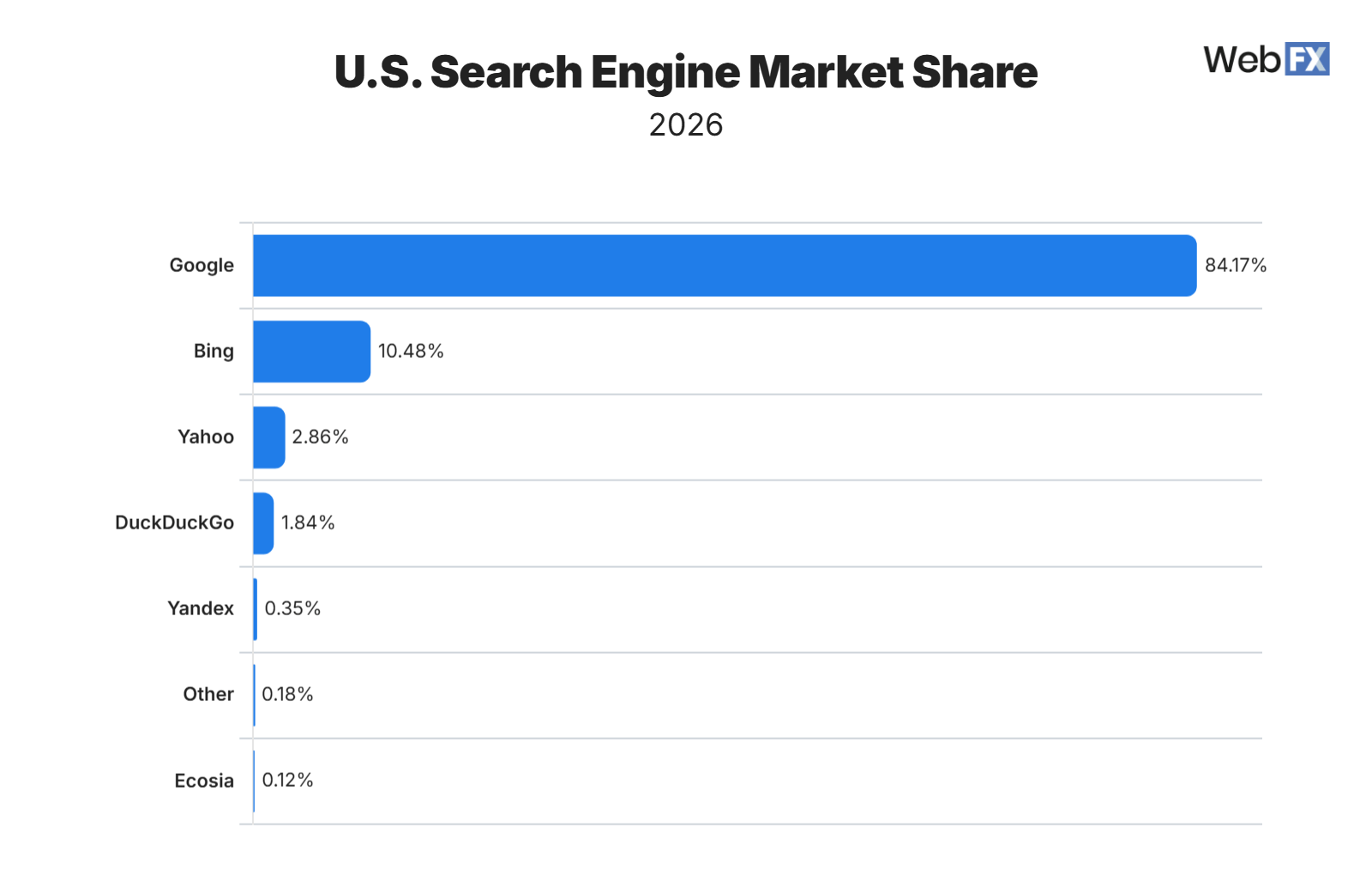
Table view
U.S. search engine market share in 2026
| Search engine | U.S. market share |
| 84.17% | |
| Bing | 10.48% |
| Yahoo | 2.86% |
| DuckDuckGo | 1.84% |
| Yandex | 0.35% |
| Other | 0.18% |
| Ecosia | 0.12% |
Google’s 84.17% might still look dominant, but it tells only part of the story. These numbers measure page-view referrals: when a search engine sends a user to a website. They don’t capture AI chatbot queries, voice search, zero-click interactions, or discovery that happens inside platforms like Amazon, TikTok, or Reddit.
When you zoom out to how all U.S. traffic breaks down by discovery channel, the picture shifts:
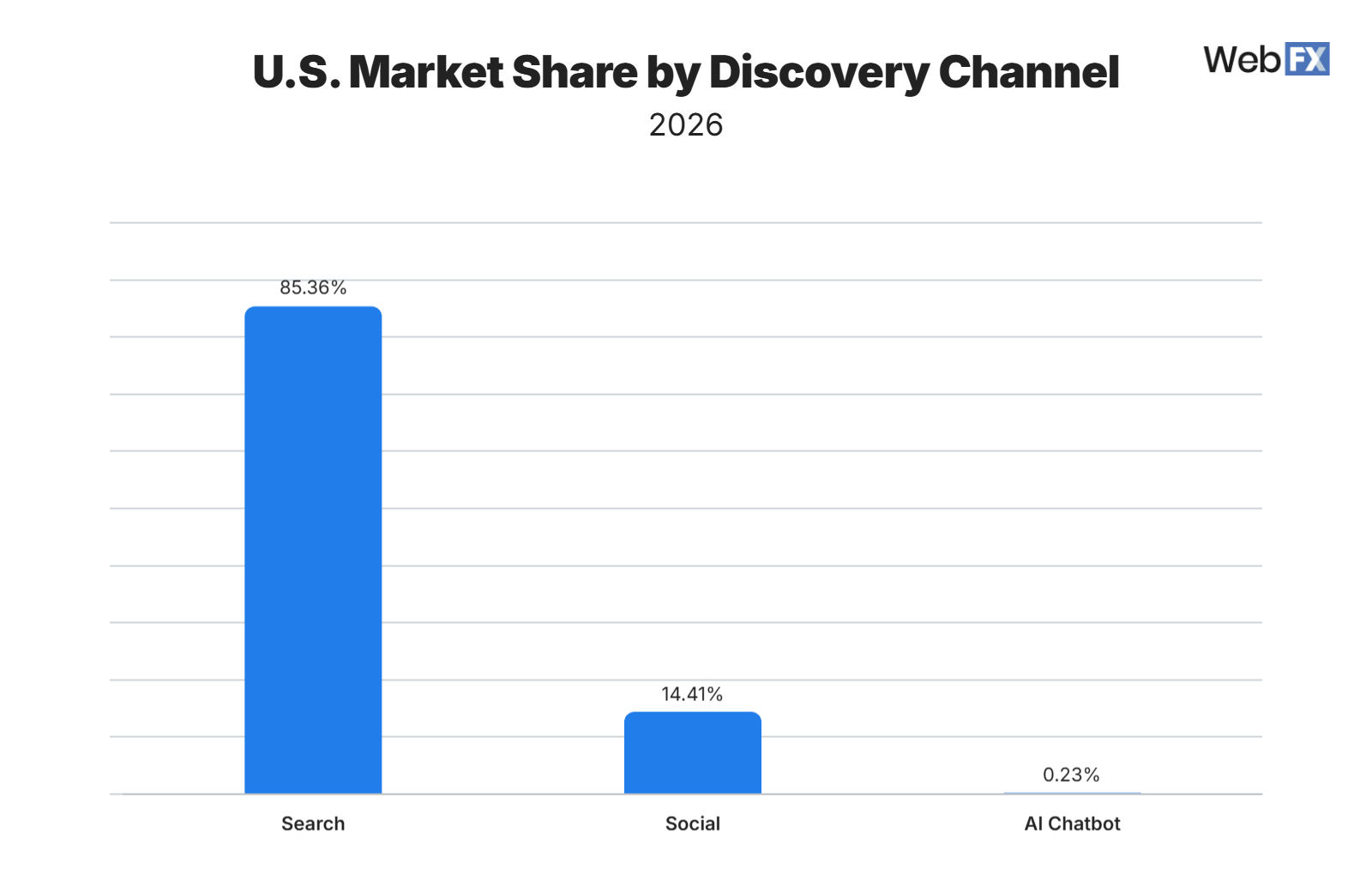
Table view
U.S. market share by discovery channel in 2026
| Discovery channel | U.S. market share |
| Search | 85.36% |
| Social | 14.41% |
| AI chatbot | 0.23% |
Search drives 85.36% of U.S. referral traffic, with social platforms capturing 14.41% and AI chatbots at 0.23%. AI chatbots represent the smallest share by volume, but the fastest-growing category StatCounter tracks. That growth trajectory, combined with the measurement gaps outlined above, defines the five hard truths below.
The 5 hard truths about today’s search market share
Now that you have the baseline data, here are the five hard truths shaping search market share in 2026:
1. Is Google losing search market share?
Google search market share declined in most U.S. metrics over the past 12 months, losing more than three points in overall share. Here’s a glance at the data:
| Google search market share in the U.S. by platform | February 2025 | February 2026 | YoY Trend |
| Overall search market share (all platforms) | 87.28% | 84.17% | Declining |
| Desktop search share | 75.62% | 77.43% | Growing |
| Mobile search share | 94.73% | 93.34% | Declining |
| Tablet search share | 85.45% | 73.07% | Weakest segment |
Google sits below 85% in the U.S. for the first time in overall share. StatCounter’s historical data shows Google dipped below 90% globally for three consecutive months in Q4 2024 (October through December). That marked the first sustained sub-90% stretch in over a decade.
The tablet segment tells the sharpest story. Google’s U.S. tablet search share dropped from 85.45% to 73.07% in 12 months, the steepest single-device decline in any segment.
Almost every non-Google search engine in the U.S. gained or held steady over the past year. Only Google and DuckDuckGo experienced declines. These are the search engines that gained (or also lost) as the Google search market share declined in the U.S.:
| Search engine | February 2025 | February 2026 | 12-month trend |
| Bing | 7.48% | 10.48% | Highest-ever share |
| Yahoo | 2.65% | 2.86% | Stable |
| DuckDuckGo | 2.07% | 1.84% | Declined |
| Yandex | 0.26% | 0.35% | Stable |
Why browser defaults play a crucial role
The reason Google maintains a strong share across platforms comes down to browser defaults. Here’s a look at who controls the U.S. browser market share in 2026:
| Browser | U.S. Share | Default Search Engine |
| Chrome | 51.55% | |
| Safari | 30.75% | |
| Edge | 8.14% | Bing |
| Firefox | 3.32% | |
| Brave | 2.62% | Brave Search |
| Samsung Internet | 1.50% | |
| Other | 2.12% | Various |
Google controls the default search setting on browsers representing more than 87% of U.S. web traffic (Chrome, Safari, Firefox, and Samsung Internet combined). That default advantage explains why Google’s mobile share (93.34%) runs so much higher than desktop (77.43%), where users encounter more browser variety and can more easily switch defaults.
Meanwhile, these default deals now face legal pressure after the DOJ’s antitrust remedies against Google banned exclusive search distribution contracts, which could accelerate Google’s search market share decline.
Nevertheless, Google still processes more than 5 trillion searches each year and dominates both U.S. and global search. That dominance isn’t going anywhere soon, which means search engine optimization (SEO) remains one of the most effective strategies for driving organic traffic, leads, and revenue.
2. How much search market share does ChatGPT actually have?
ChatGPT holds 0.23% of the U.S. search market share based on referral data. This metric reflects how often it sends users to external websites compared to traditional search engines.
At first glance, that makes the AI search market share look small. But most AI interactions happen inside the chat without generating a click, which means traditional search engine market share data misses a large portion of AI usage.
So while the current AI search market share sits at 0.23% by referral, it does not reflect how often users rely on AI for research, comparisons, and decision-making.
Who leads the AI chatbot market share?
Here’s how the major platforms compare in the U.S.:
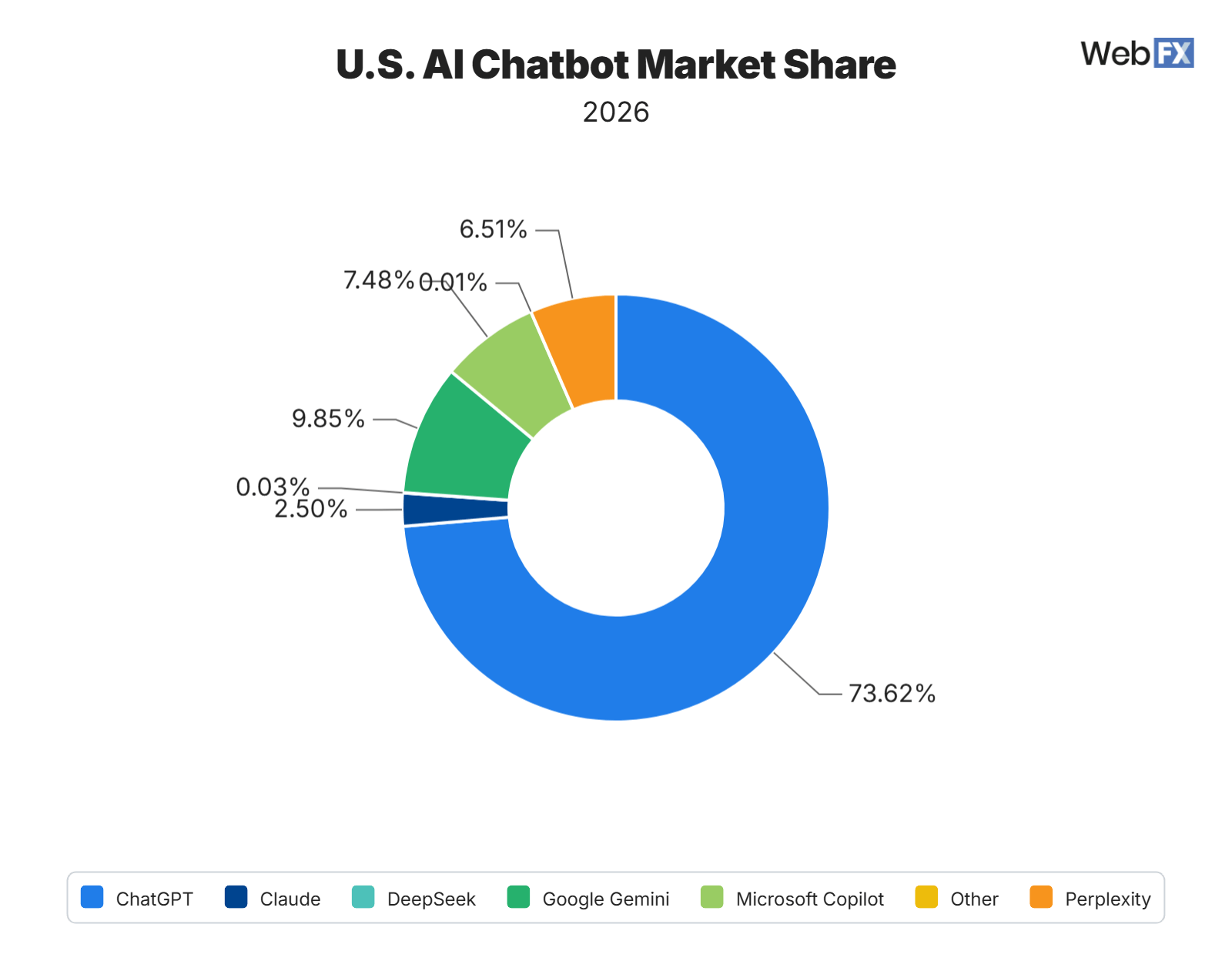
Table view
U.S. AI chatbot market share in 2026
| AI chatbot | U.S. market share |
| ChatGPT | 73.62% |
| Google Gemini | 9.85% |
| Microsoft Copilot | 7.48% |
| Perplexity | 6.51% |
| Claude | 2.50% |
| DeepSeek | 0.03% |
| Other | 0.01% |
The current AI search market share remains small by volume, but its influence continues to grow. Users rely on AI tools to summarize information, compare options, and shape decisions before clicking a result.
The takeaway is simple: optimize for both traditional search and AI discovery.
If AI platforms cannot find or accurately describe your business, you lose visibility before a user even reaches Google. Generative engine optimization (GEO) helps you build that visibility across ChatGPT, Perplexity, Gemini, and other AI search tools.
3. What percentage of searches end without a click?
Nearly 60% of Google searches now end without a click to any website.
The primary driver behind the growth in zero-click search is Google’s AI Overviews. Our analysis of 2.37 million U.S. search queries revealed that 25.8% of searches now trigger an AI Overview box, and that rate climbs past 50% for queries with seven or more words.
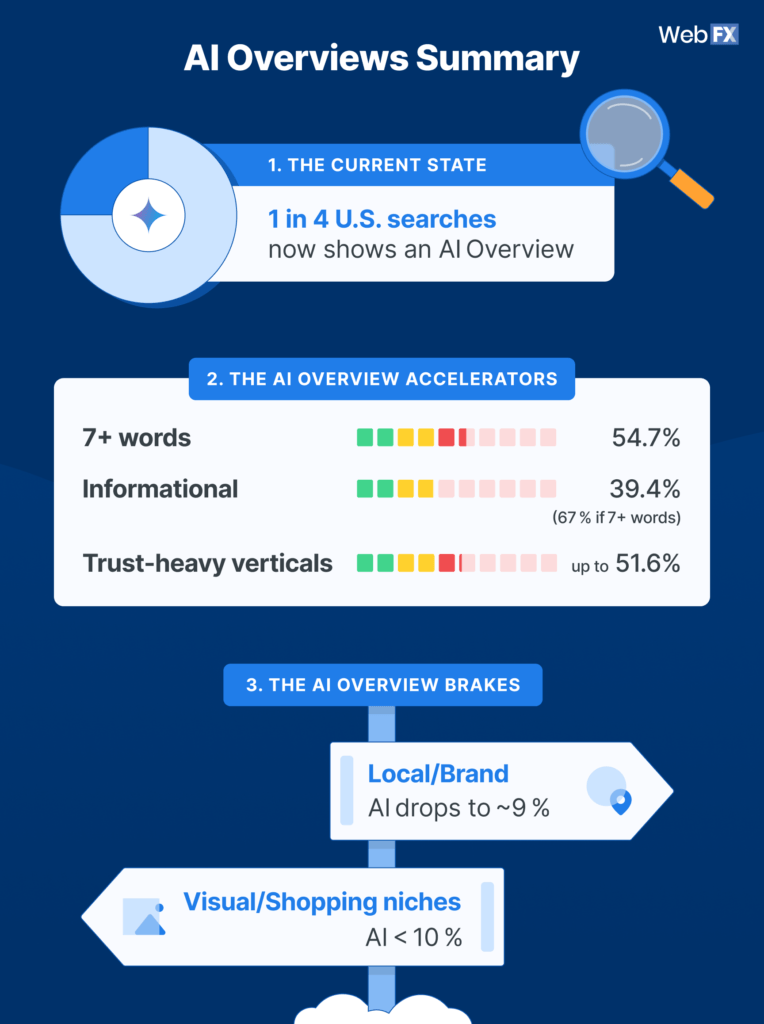
Google’s newer AI Mode pushes the trend further. Semrush reports that 93% of AI Mode searches end with zero clicks, meaning users get answers entirely within Google’s interface.
In practical terms, you can rank on page one, gain impressions year over year, and still watch traffic decline. That shift makes it critical to measure how your site performs in AI Overviews now.
Use our free AI Overview Checker to find out how visible your website is in AI Overviews. It also shows which sites earn citations for the keywords you rank for, helping you build a clear plan to improve your AI visibility.
4. What is Bing’s search engine market share in 2026?
Bing holds 10.48% of the U.S. search engine market share, its highest figure ever.
Here’s a closer look at Bing’s search market share in the U.S. by platform:
| Segment | February 2025 | February 2026 | YoY Trend |
| All platforms | 7.48% | 10.48% | Growing |
| Desktop | 17.43% | 16.66% | Declining |
| Mobile | 1.05% | 1.93% | Growing |
| Tablet | 10.6% | 22.94% | Strongest segment |
At 10.48%, Bing captures roughly one in every 10 U.S. searches, a three-point gain in overall share over the past 12 months. The growth ties closely to one strategic bet: AI integration.
Microsoft launched Copilot (originally Bing Chat) in early 2023, making Bing the first major search engine to embed generative AI into its core experience. That first-mover advantage gave Bing a clear differentiation point beyond traditional search quality.
Today, Copilot runs embedded across Windows, Microsoft Edge, Office 365, and Microsoft Teams. That integration increases exposure to Bing-powered AI search across multiple touchpoints, even as growth varies by device.
At 10.48%, Bing delivers enough volume to justify dedicated optimization. If you’re not tracking Bing Webmaster Tools or considering how Copilot surfaces your content, you’re leaving measurable visibility on the table.
5. Is DuckDuckGo still growing its search market share?
DuckDuckGo holds 1.84% of the U.S. search market share, maintaining its position as the leading privacy-focused search engine but no longer showing the rapid growth that defined its 2019-2022 trajectory.
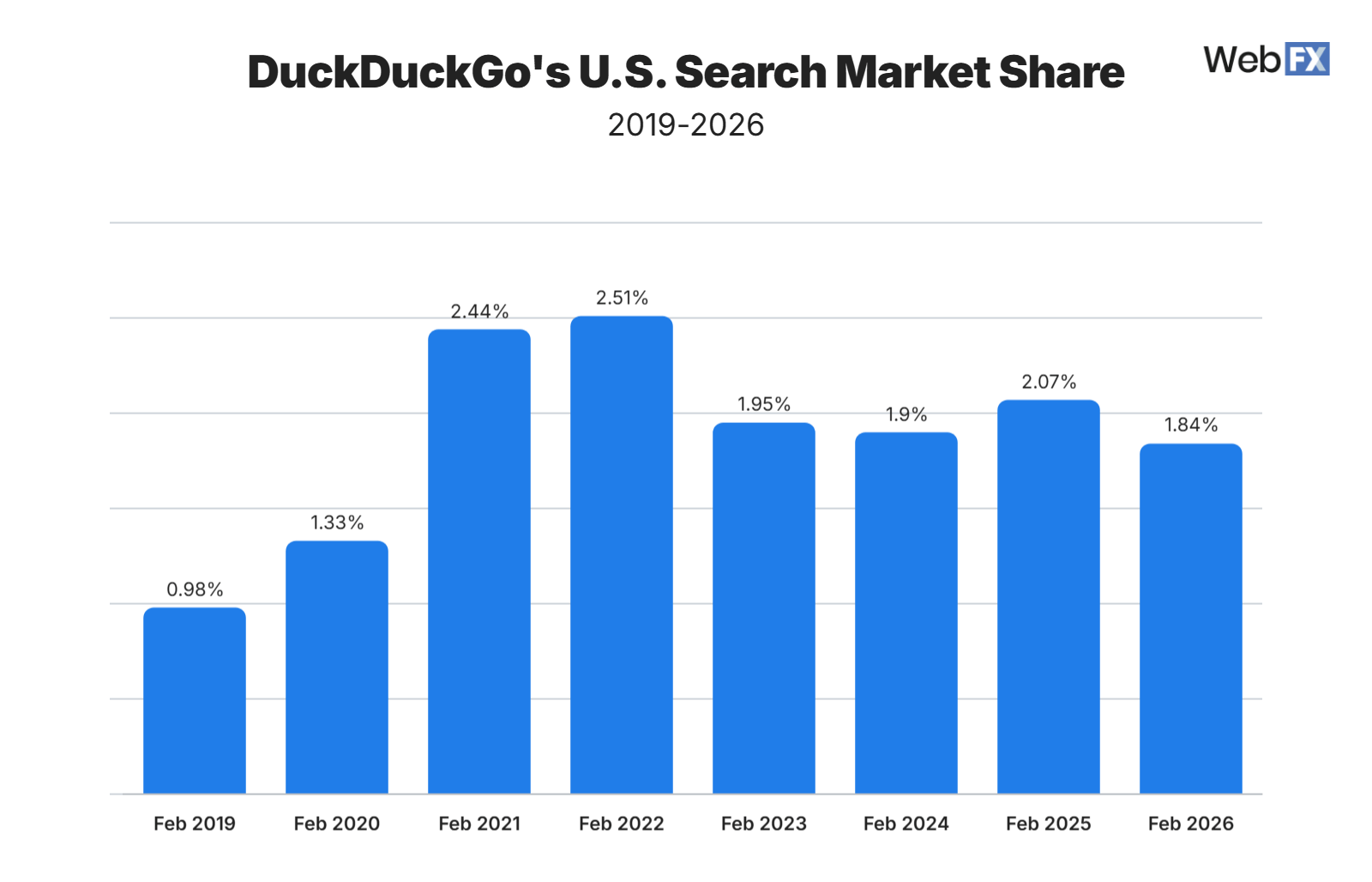
Table view
DuckDuckGo’s U.S. search market share (2019-2026)
| Year | DuckDuckGo’s U.S. search market share (all platforms) |
| February 2026 | 1.84% |
| February 2025 | 2.07% |
| February 2024 | 1.9% |
| February 2023 | 1.95% |
| February 2022 | 2.51% |
| February 2021 | 2.44% |
| February 2020 | 1.33% |
| February 2019 | 0.98% |
DuckDuckGo more than doubled its U.S. search market share between 2019 and 2022, fueled by growing privacy awareness after data concerns involving Facebook and Google. Apple made DuckDuckGo a search option for iOS and Safari in 2014, and Mozilla added it to Firefox. That support from major browser makers gave DuckDuckGo the distribution it couldn’t have built alone.
In 2026, DuckDuckGo’s growth has stabilized. The 1.84% U.S. share represents a solid position, but the explosive growth phase appears to have plateaued. The reason ties back to the broader search market share story, where AI disruption is emerging as a stronger competitive force than privacy.
Platforms like ChatGPT, Perplexity, and Gemini introduce a new way to find information, shifting attention away from traditional search engines. DuckDuckGo’s challenge going forward involves competing not just with Google, but with an entirely new category of AI-powered discovery.
For users who prioritize privacy, DuckDuckGo remains the strongest option among traditional search engines. But the 2026 search market share story has moved past privacy as the main catalyst for change.
How should you adapt your search strategy to these market share shifts?
Your search strategy in 2026 should account for five shifts: Google’s declining U.S. search market share, the rise of AI discovery, zero-click dominance, Bing’s record growth, and the emergence of other discovery channels.
Here are five concrete moves tied to the hard truths above:
1. Audit your AI visibility
Search your brand in ChatGPT, Perplexity, and Google Gemini using real customer queries (e.g., “best [service] near me” or “top companies for [problem]”). Track whether your brand is mentioned, cited, or skipped entirely. Then, validate performance using tools like Google Search Console, Semrush, or GA4 to identify AI-driven impressions and traffic.
If these platforms can’t find or accurately describe your business, you’re invisible in a rapidly growing discovery channel. Learn more about how to track AI search rankings.
2. Optimize for zero-click
Structure your content to win visibility inside AI Overviews and SERP features, and not just clicks. Lead with direct answers, use FAQ schema, and format content with lists, tables, and clear headings.
Nearly 60% of Google searches now end without a click, often because users get answers directly in the SERP. That means visibility now matters as much as traffic. Learn how to optimize for zero-click SEO.
3. Track beyond rankings
Expand your reporting beyond keyword positions. Track metrics like AI Share of Voice, AI Inclusion Rate, and visibility in AI Overviews.
If impressions rise while clicks fall, your content may still be influencing decisions, just without generating traffic. Rankings alone no longer tell the full story.
4. Don’t ignore Bing
At 10.48% U.S. share, Bing represents a meaningful slice of search demand. Optimize specifically for Bing by targeting long-tail keywords, aligning with user intent, improving page speed, and strengthening internal and external links.
With Microsoft Copilot embedded across its ecosystem, Bing plays a growing role in AI-powered discovery. Learn more about how to improve your visibility on Bing.
5. Invest in search everywhere optimization
Your audience no longer searches in one place. They discover brands across Google, AI chatbots, social platforms, voice assistants, and marketplaces.
AI search optimization services, supported by the OmniSEO® platform, expand your visibility across all of these channels, aligning your strategy with how different audiences actually search today.
Show Up Everywhere Your Buyer is Searching
Buyers are discovering brands in sources beyond Google and ChatGPT. Find out where your audience is searching and get in front of them with WebFX.
FAQs about search market share
What is the current search engine market share in 2026?
Search engine market share in 2026 is led by Google at 84.17% in the U.S., while Bing holds 10.48%, followed by Yahoo at 2.86% and DuckDuckGo at 1.84%.
What is Bing’s market share in 2026?
Bing’s market share in 2026 reached 10.48% in the U.S., its highest-ever share. Microsoft’s integration of Copilot AI across Windows, Edge, and Office 365 drove the growth.
Is Google losing search market share?
Google search market share declined to 84.17% in the U.S. as of February 2026, below 85% for the first time. Most other search engines gained or held share over the same period.
What is ChatGPT’s share of the search market?
ChatGPT’s search market share sits at 0.23% of U.S. search referrals and leads the AI chatbot market share with 73.62% share.
How are AI search engines affecting search market share?
AI search engines create a parallel discovery layer that traditional metrics undercount. AI chatbots hold 0.23% of U.S. traffic share, but their influence extends beyond what referral data captures.
What percentage of searches are zero-click in 2026?
Nearly 60% of Google searches end without a click. AI Overviews trigger on 25.8% of U.S. searches, and CTR drops 58% when one appears.
How does search market share differ by device?
Google holds 93.34% of U.S. mobile search, but only 77.43% of desktop and 73.07% of tablet. Bing’s desktop share runs at 16.66% in the U.S., while mobile stays at 1.93%.
What should marketers do about search market share changes?
Marketers should audit AI visibility across ChatGPT, Perplexity, and Gemini; optimize for zero-click and AI Overview inclusion; track AI Share of Voice alongside rankings; invest in Bing optimization; and build visibility across the full discovery ecosystem.
Search has changed. Your strategy should, too.
Search market share in 2026 tells a more complicated story than a single number. Ranking on Google still matters, but it no longer captures the whole picture. The businesses that build visibility across traditional search, generative AI, social platforms, and zero-click environments capture more of the search ecosystem and the revenue that comes with it.
With 30+ years of experience and a team of 750+ digital experts, WebFX helps businesses like yours stay visible through every search shift. The OmniSEO® platform future-proofs your brand’s visibility everywhere — with data-driven insights and next-gen software to track and prove impact, backed by a tailored AI search optimization strategy from our team.
Your SEO investment built the foundation. Now it needs to evolve with how people search today. Get your free proposal or call 888-601-5359 to speak with a strategist today.
-
 Sarah Berry is a Lead SEO Consultant at one of the largest digital marketing agencies in the USA — WebFX. With more than 10,000 hours of experience, she offers practical insights and strategies to grow your digital revenue. Her work has been cited by Michigan State University, Business Insider, and Ars Technica. When she isn’t polishing her Time Magazine Person of the Year Award, she’s spending time with her flock of ducks. View full profile
 -

WebFX is a full-service digital marketing agency delivering revenue-driving strategies across online advertising, SEO and AI search optimization, and digital marketing. Backed by 1,100+ client reviews, a 4.9-star rating on Clutch, and proprietary revenue-tracking technology, our team helps businesses grow visibility and revenue across platforms, from Google to ChatGPT to LinkedIn. Discover how our expert team and revenue-accelerating tech can drive results for you. Learn more

Try our free Marketing Calculator
Craft a tailored online marketing strategy! Utilize our free Internet marketing calculator for a custom plan based on your location, reach, timeframe, and budget.

Contents
- What is the current search engine market share in 2026?
- The 5 hard truths about today's search market share
- 1. Is Google losing search market share?
- 2. How much search market share does ChatGPT actually have?
- 3. What percentage of searches end without a click?
- 4. What is Bing's search engine market share in 2026?
- 5. Is DuckDuckGo still growing its search market share?
- How should you adapt your search strategy to these market share shifts?
- 1. Audit your AI visibility
- 2. Optimize for zero-click
- 3. Track beyond rankings
- 4. Don't ignore Bing
- 5. Invest in search everywhere optimization
- FAQs about search market share
- Search has changed. Your strategy should, too.
Share this article


SEO Success with KOA

Try our free Marketing Calculator
Craft a tailored online marketing strategy! Utilize our free Internet marketing calculator for a custom plan based on your location, reach, timeframe, and budget.